
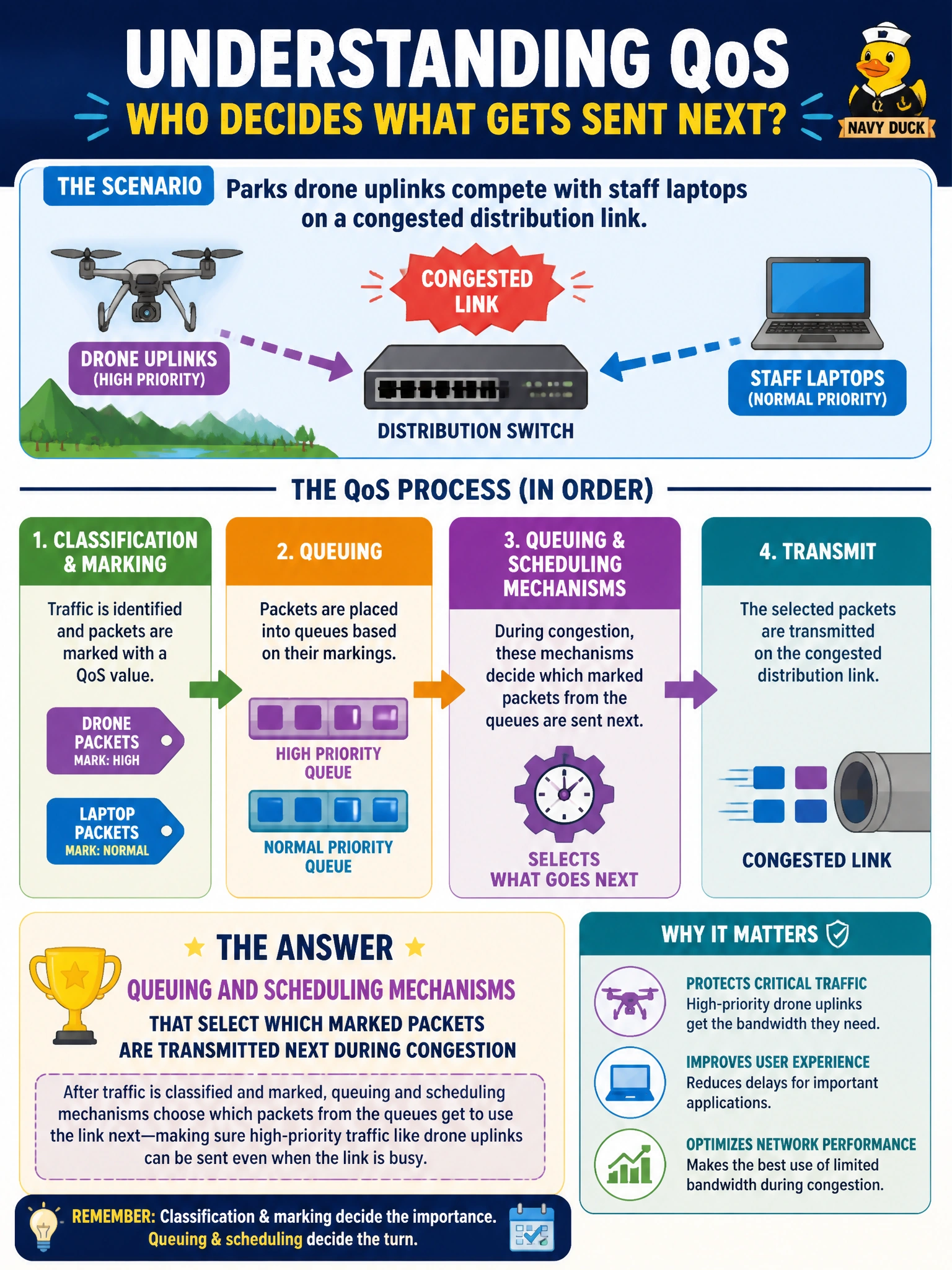
Parks drone uplinks compete with staff laptops on a congested distribution link. Which QoS component is responsible for scheduling packets from queues after traffic has already been classified and marked?
Select an answer to reveal the explanation.
Short Explanation
Classification puts the drone video in the red bin and the laptop bulk in the blue bin. Queuing is the worker who actually decides which bin gets emptied onto the wire when the link is slammed.
Full Explanation
After traffic is classified and marked, something must still choose which packets leave a congested interface next. That responsibility belongs to queuing and scheduling mechanisms. On a parks distribution link where drone uplinks compete with staff laptops, classification may place drone video and laptop bulk into different classes, but queuing/scheduling is the component that actually dequeues marked packets according to priority or bandwidth policy during congestion.
NAT overload that hides private addresses before routing is an address translation function, not a packet scheduler. DHCP snooping builds IP-to-MAC binding information for security validation and does not select which marked queue is served next. VRRP provides a virtual default gateway IP for first-hop redundancy and likewise is not a QoS scheduling engine.
Exam caveat: stems that say 'after traffic has already been classified and marked' are pointing past classification into the scheduler. Do not grab the first familiar feature acronym in the distractors.
Operational check: show policy-map interface statistics on the congested distribution link, confirm separate queues for drone and laptop classes, and validate that scheduling matches the intended priority or bandwidth weights when both compete.