
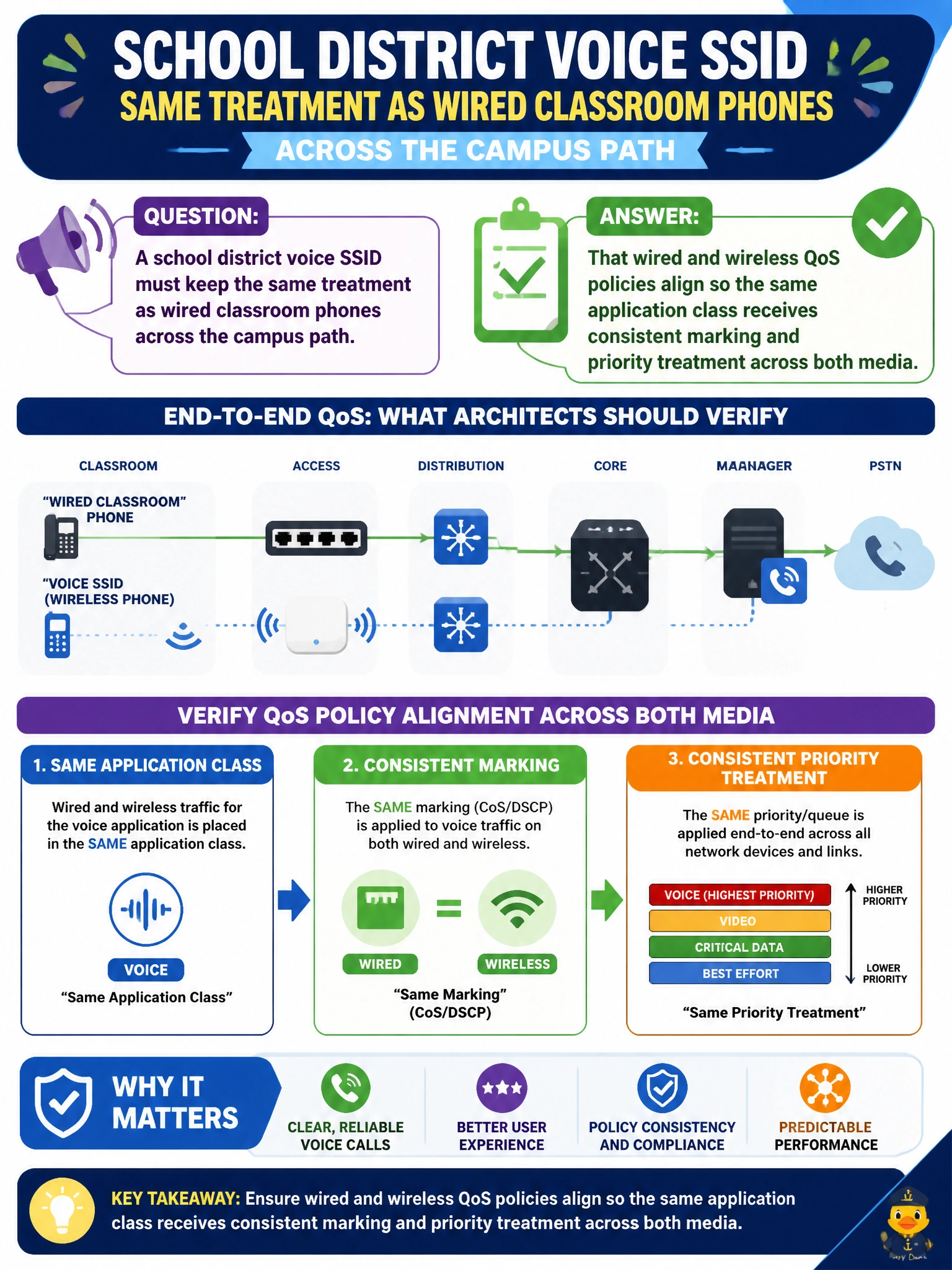
A school district voice SSID must keep the same treatment as wired classroom phones across the campus path. What should architects verify when interpreting end-to-end QoS?
Select an answer to reveal the explanation.
Short Explanation
If the wired phone gets the express lane but the wireless softphone gets tossed in bulk mail at the AP, the call still sounds awful. End-to-end means the same class of traffic keeps its sticker from air to wire.
Full Explanation
End-to-end QoS for a school district means the same application class should receive consistent treatment whether the media path is wired classroom phones or a voice SSID. Architects must verify that wired and wireless QoS policies align so marking and priority treatment stay consistent across both media. If wireless voice is remarked or queued differently from wired voice at the AP, WLC, or CAPWAP boundary, call quality can collapse even when the wired campus policy looks correct in isolation.
Configuring wireless voice as best-effort while wired phones use process switching fails both sides of the requirement: voice should not be best-effort on WLAN when the design calls for preferential treatment, and process switching is not a QoS strategy for wired phones. Disabling all DSCP trust on the WLC so CAPWAP always remarks to CS0 actively destroys end-to-end consistency. Applying QoS only on the wireless side because wired campus links 'never congest' ignores real uplink and distribution congestion and breaks the end-to-end interpretation ENCOR emphasizes.
Exam caveat: wireless/wired QoS items often hide a trust or remarking break at the CAPWAP edge. The scoring idea is aligned treatment for the same class across media, not media-specific excuses.
Operational check: trace DSCP/CoS from wired phone ports and from wireless voice clients through AP/WLC and into the campus queues, confirm trust and rewrite points preserve the voice class, and load-test a congested hop to ensure both paths still receive priority treatment.