
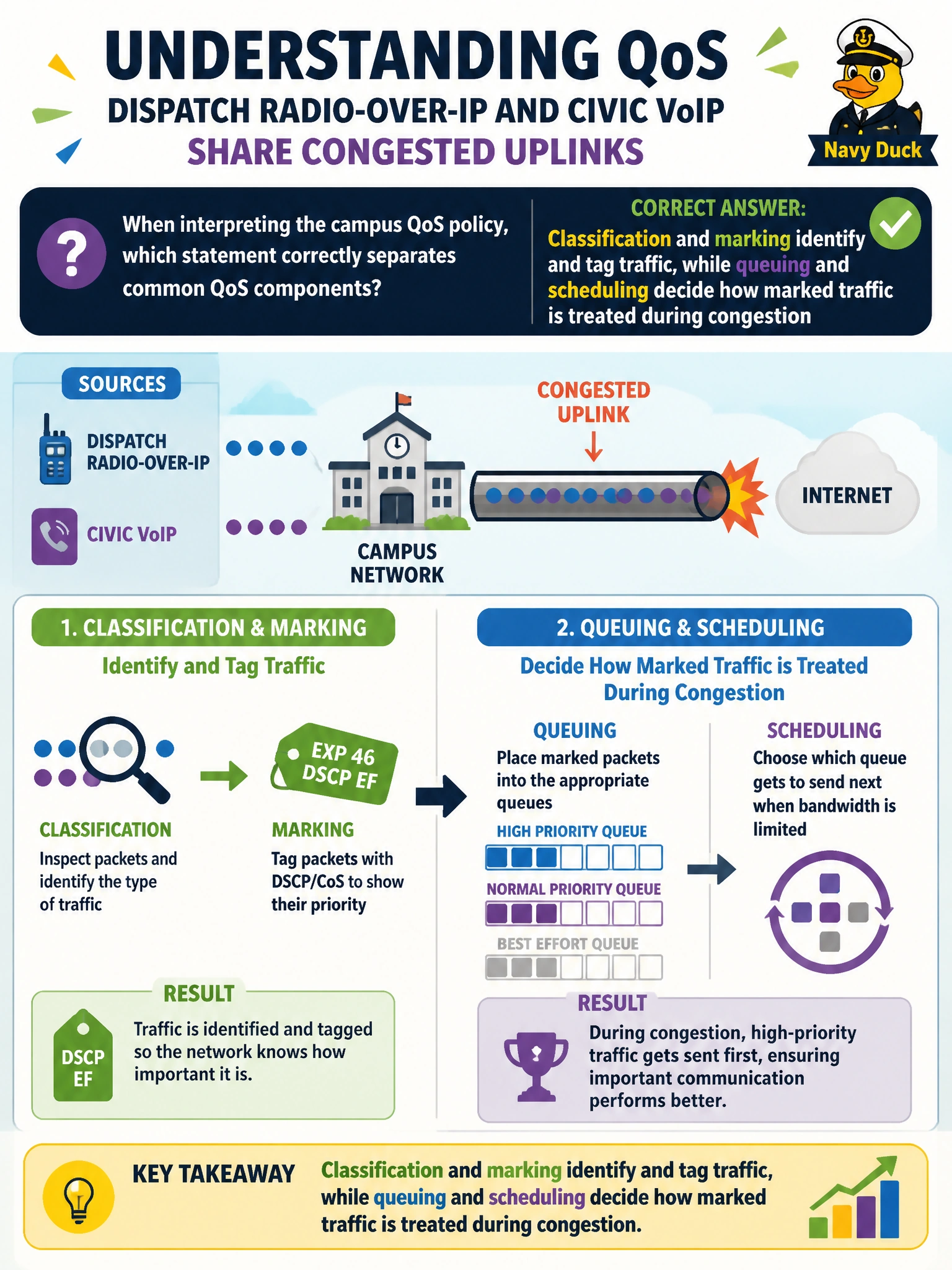
Dispatch radio-over-IP and civic VoIP share congested uplinks. When interpreting the campus QoS policy, which statement correctly separates common QoS components?
Select an answer to reveal the explanation.
Short Explanation
Classification is sorting the mail; marking is stamping the priority sticker; queuing is deciding which stamped pile gets on the truck first when the dock is jammed. Mix those jobs up and the dispatch radio starts waiting behind bulk uploads.
Full Explanation
Campus QoS for dispatch radio-over-IP and civic VoIP is easier to troubleshoot when staff separate identification from congestion treatment. Classification and marking identify traffic and apply tags such as DSCP or CoS so downstream hops can recognize application classes. Queuing and scheduling then decide, during congestion on shared uplinks, which marked packets are transmitted, delayed, or dropped according to policy. That separation is the ENCOR-level interpretation the question asks for: identify/tag first, then treat marked traffic under load.
Saying queuing renumbers IP addresses while classification only encrypts CAPWAP headers invents functions neither component performs—address renumbering is not a queueing job, and classification is not an encryption service for CAPWAP. Claiming marking replaces OSPF with EIGRP so voice always wins, while classification disables CEF, mixes routing protocol choice and CEF with QoS marking and is operationally nonsensical. Treating policing and shaping as identical tools that permanently delete unmarked frames at the access edge collapses two distinct rate tools into one incorrect story: policing can drop or remark excess immediately, shaping buffers and smooths, and neither is defined as 'delete everything unmarked at the edge' as a universal rule.
Exam caveat: QoS distractors often splice routing, CEF, or wireless encapsulation onto classification/marking/queuing vocabulary. Hold the definitional line between identify/tag versus schedule under congestion.
Operational check: inspect class maps and marking at trust points for radio-over-IP and VoIP, then verify queueing policies on congested uplinks show those markings receiving the intended priority or bandwidth share rather than competing as unmarked best-effort.