
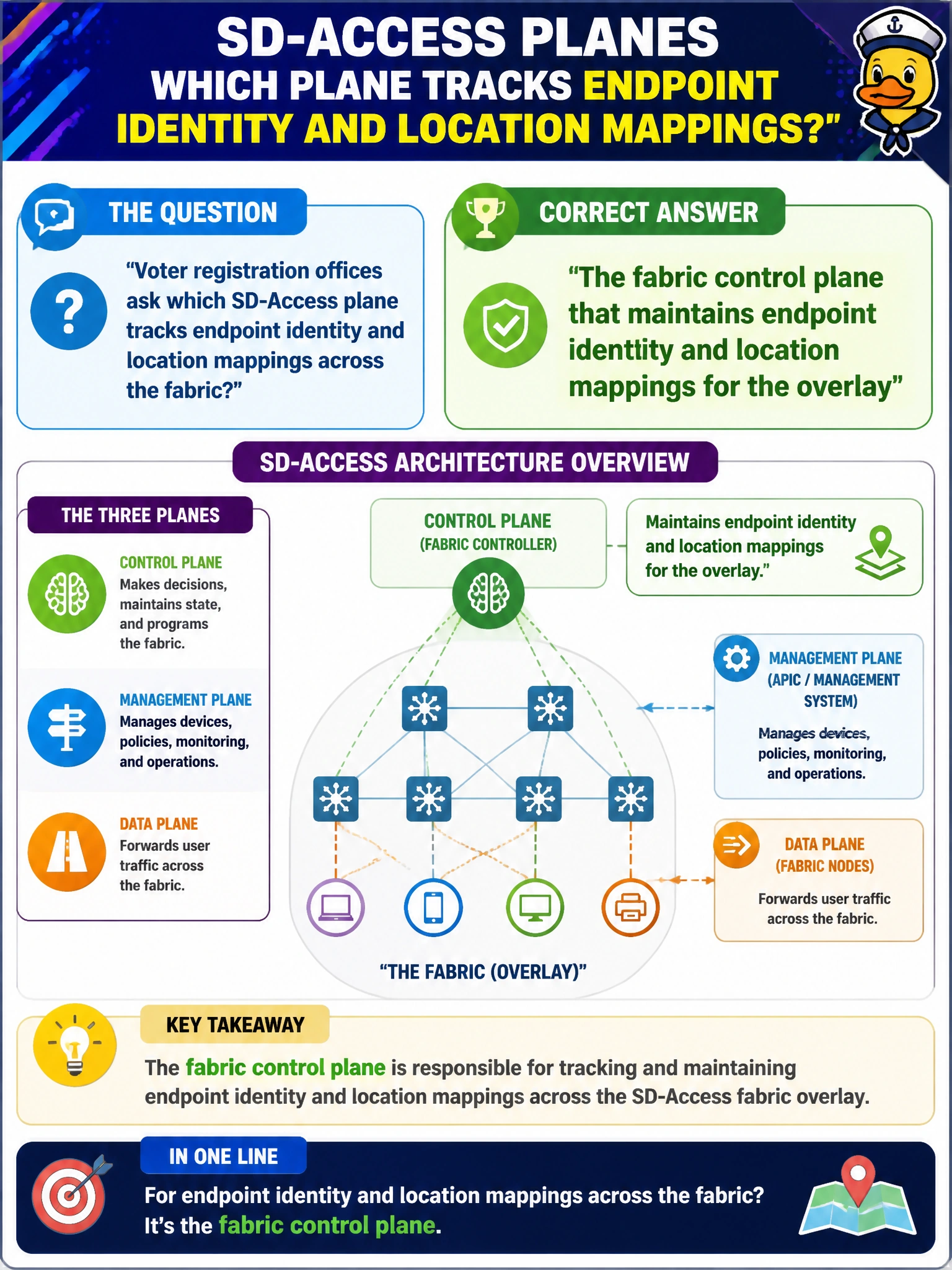
Voter registration offices ask which SD-Access plane tracks endpoint identity and location mappings across the fabric?
Select an answer to reveal the explanation.
Short Explanation
Think of the control plane as the receptionist who knows who walked in and which floor they are on. The data plane carries the traffic; the receptionist (control plane) keeps the identity and location directory straight.
Full Explanation
SD-Access separates responsibilities across planes so municipal operators can reason about identity separately from raw forwarding. The fabric control plane is the plane that maintains endpoint identity and location mappings for the overlay. In a voter registration office fabric, that mapping function is what lets the system know which endpoint is where and how fabric nodes should resolve destinations when policy and overlay forwarding are applied. ENCOR expects candidates to associate identity/location tracking with the control plane rather than with opportunistic data-plane or management-plane features.
A wireless QoS data plane that only marks DSCP on CAPWAP tunnels addresses marking treatment for wireless traffic; it does not maintain fabric-wide endpoint identity and location tables. An underlay multicast plane used solely for PIM dense mode flooding describes a possible underlay transport behavior, not the LISP-style or fabric control mapping service that tracks who is attached where. A management plane syslog collector that supposedly replaces LISP mappings confuses operational logging with the control-plane mapping system; syslog may record events, but it does not provide the fabric's authoritative identity/location resolution path for overlay forwarding.
Exam caveat: plane questions are easy to miss when an option mentions a real technology (QoS, multicast, syslog) that simply answers a different job. Match the verb in the stem—'tracks endpoint identity and location mappings'—to the control plane.
Operational check: review control-plane node status and endpoint map caches for registration-office prefixes, confirm edge nodes are registering and resolving identities correctly, and treat data-plane counters or syslog feeds as supporting telemetry rather than as substitutes for the mapping plane.