
Airport operations wants SD-Access in new terminals but must keep legacy printers reachable on a non-fabric floor. Which statement best reflects traditional campus interoperability?
Select an answer to reveal the explanation.
Short Explanation
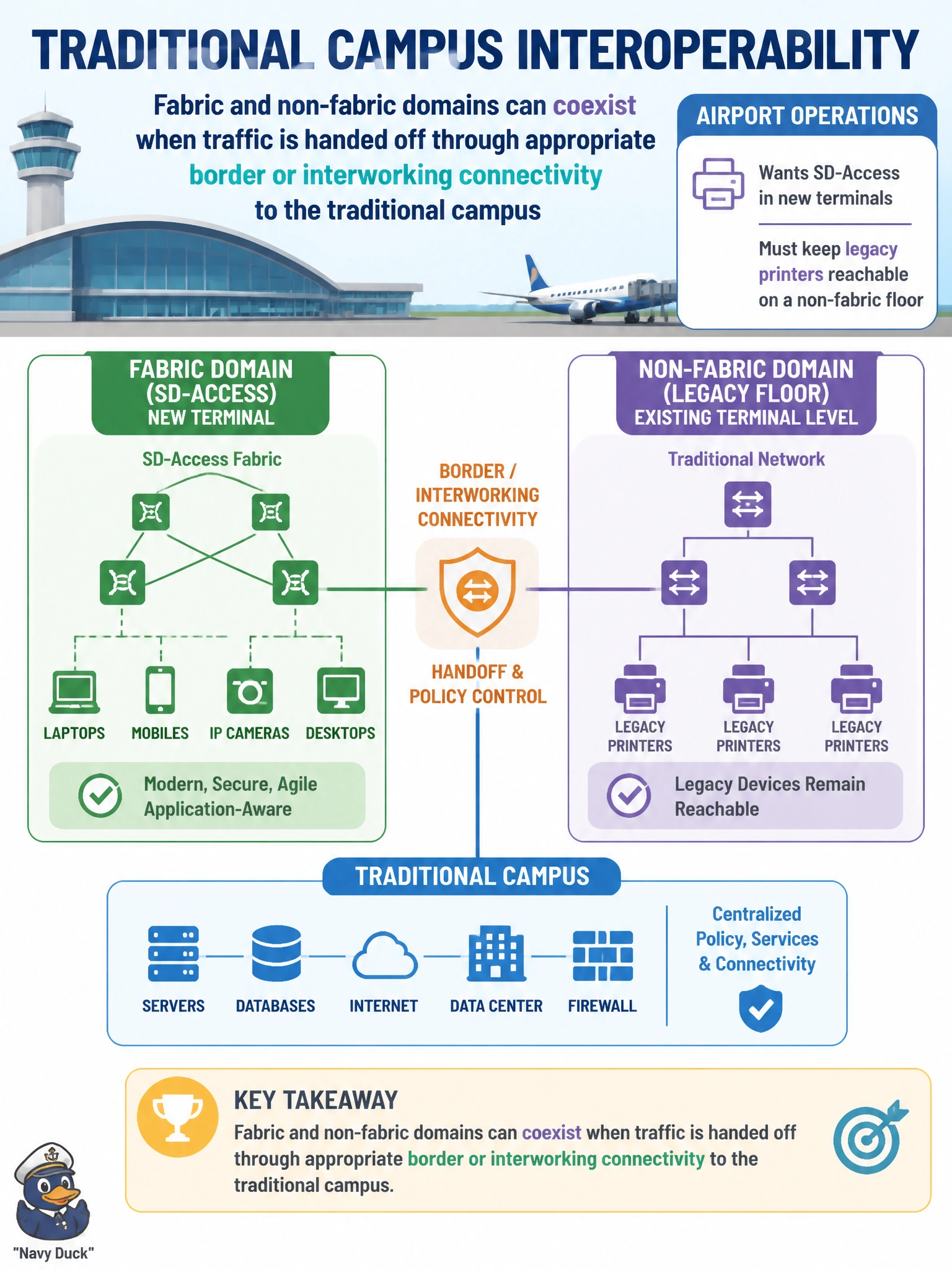
New terminals can join the fabric club while the old printer floor stays classic—as long as there is a handoff desk between the two. That desk is the border/interworking path, not a rule that says every printer has to vanish on day one.
Full Explanation
Traditional campus interoperability is a first-class SD-Access design expectation on ENCOR, especially in civic environments such as airports where new terminals may adopt fabric while older floors still host legacy printers. Fabric and non-fabric domains can coexist when traffic is handed off through appropriate border or interworking connectivity to the traditional campus. That handoff preserves reachability for devices that are not yet migrated without requiring every endpoint to join the fabric on day one.
Abandoning legacy printers because SD-Access supposedly cannot coexist with any non-fabric VLAN contradicts the migration and interoperability model. Non-fabric VLANs remain valid on traditional floors when borders provide the path. Disabling IP routing on non-fabric floors and relying only on wireless FlexConnect for printer reachability misapplies a wireless branch/local-switching concept to a campus coexistence problem and removes the routed path printers typically need. Moving printers into the SD-WAN data plane before enabling any fabric edge confuses WAN overlay architecture with campus SD-Access migration; SD-WAN placement is not a prerequisite for fabric edge onboarding or for keeping traditional printers reachable through campus border interworking.
Exam caveat: distractors often drag in FlexConnect, SD-WAN, or absolute 'fabric cannot coexist' statements. The correct principle is controlled coexistence via border/interworking, not forced abandonment or unrelated overlays.
Operational check: document which printer subnets remain traditional, verify border handoff routing and any required policy between new-terminal fabric segments and those printer VLANs, and validate print jobs from fabric users before expanding fabric edge further into the airport campus.