
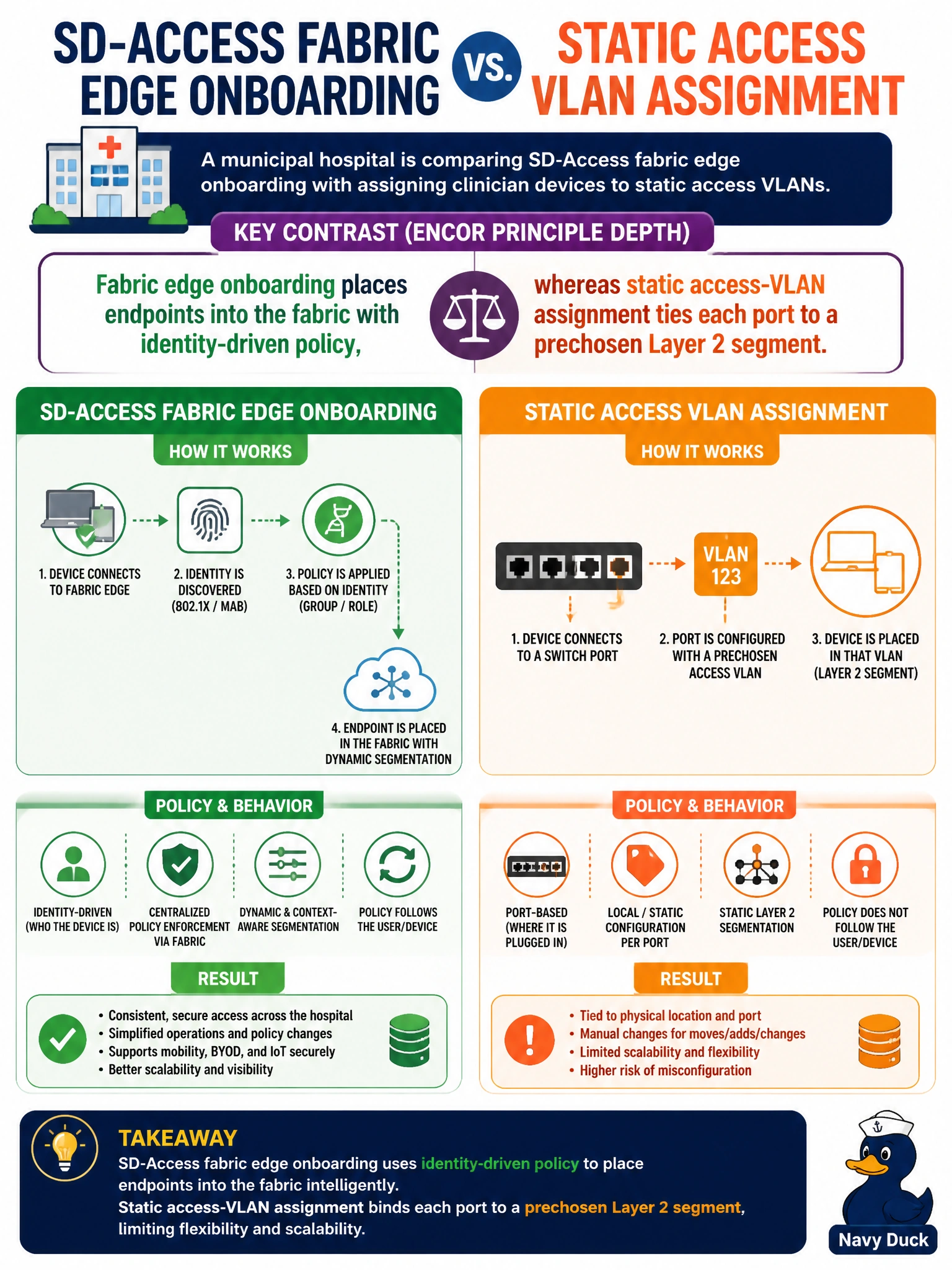
A municipal hospital is comparing SD-Access fabric edge onboarding with assigning clinician devices to static access VLANs. What is the key contrast at ENCOR principle depth?
Select an answer to reveal the explanation.
Short Explanation
Static VLANs are like assigned parking spots—you get whatever stall is painted on the curb. Fabric edge is more like a badge reader that puts you in the right lane based on who you are. Same parking garage, smarter onboarding.
Full Explanation
The ENCOR contrast between SD-Access fabric edge onboarding and static access-VLAN assignment is about how an endpoint earns its network treatment. At a municipal hospital, fabric edge nodes bring clinician devices into the fabric so identity and policy can determine virtual network membership and segmentation. Onboarding is therefore tied to who the endpoint is and what policy says it may reach, rather than solely to a paint-by-number VLAN on the wall jack. Static access-VLAN designs instead bind each port to a prechosen Layer 2 segment: whatever VLAN is configured on that interface is what the device inherits, with little dynamic identity context at the edge.
Claiming fabric edge onboarding works only for printers while clinician softphones require static VLANs invents a device-class limitation that is not the principle under test. Softphones, PCs, printers, and other endpoints can be onboarded according to design and identity sources; the key contrast remains identity-driven fabric placement versus fixed port VLAN binding. Reversing the encapsulation story—saying static VLANs use VXLAN on every access port while fabric edge uses only 802.1Q with no overlay—is factually backwards relative to SD-Access overlays. Asserting that fabric edge removes the need for any upstream routing while static VLANs require dual supervisors with SSO mixes unrelated high-availability hardware features with onboarding philosophy and incorrectly implies fabric needs no upstream fabric/core routing roles.
Exam caveat: watch for options that swap overlay and classic VLAN mechanics or that bolt HA buzzwords onto the wrong side of the comparison. Score the identity-driven fabric edge versus static Layer 2 port binding contrast.
Operational check: compare a statically assigned clinician port VLAN with a fabric-onboarded endpoint's virtual network and group policy, verify authentication/identity feeds into fabric edge assignment, and ensure upstream fabric borders and control-plane services remain in place—fabric onboarding does not delete the rest of the campus routing design.