
Stadium bowl Wi-Fi fails post-event surveys after ticket-holder density spikes. At a design-principle level, what must planners prioritize?
Select an answer to reveal the explanation.
Short Explanation
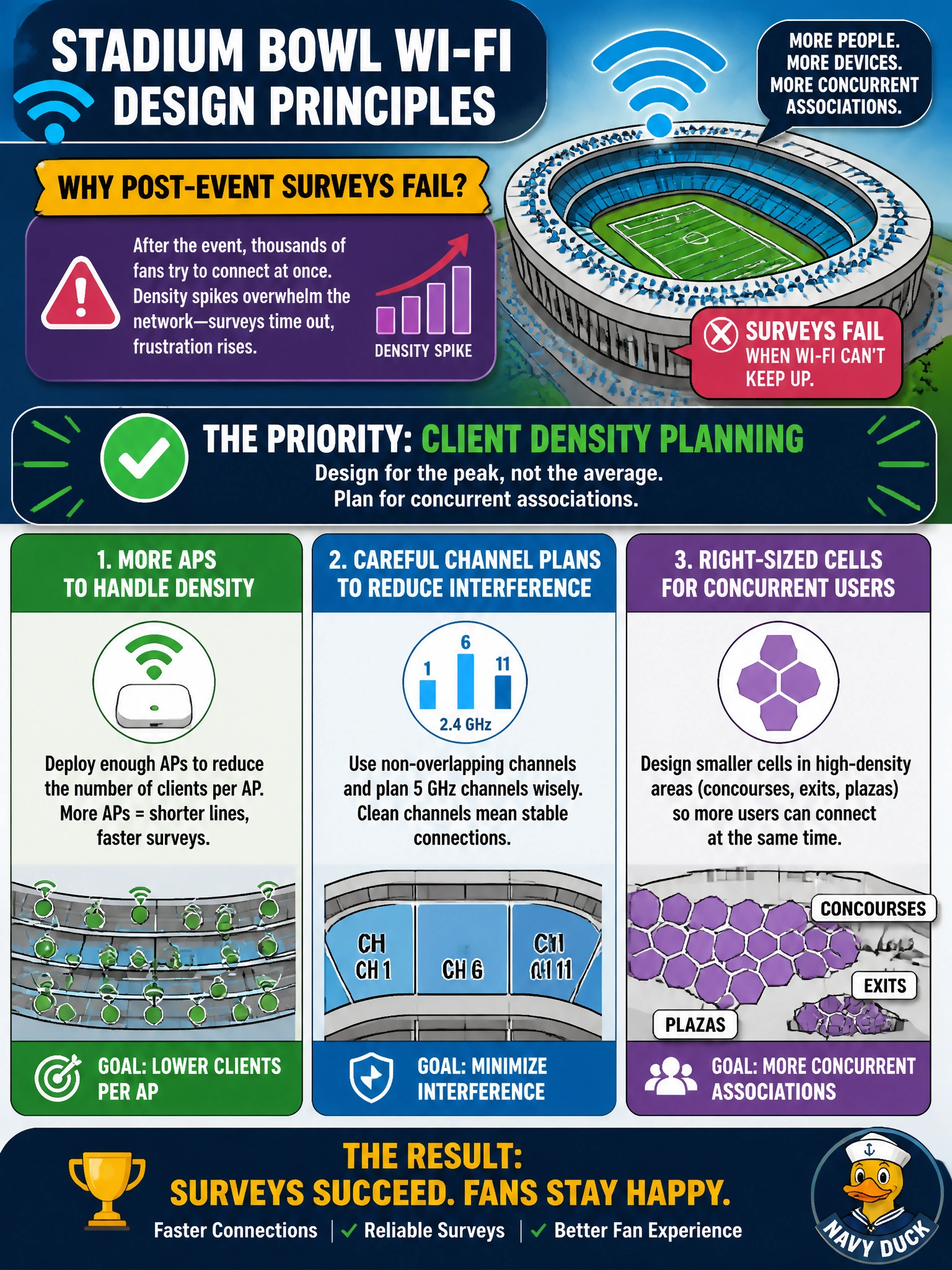
A sold-out bowl is not one living room—it’s thousands of phones in a sardine can. Density design means more carefully planned AP cells, not one megaphone AP blasting the whole stadium.
Full Explanation
Stadium bowl Wi-Fi that fails post-event surveys after ticket-holder density spikes must prioritize client density planning: more APs, careful channel plans, and cell sizing for concurrent associations and airtime. High density is a primary wireless design driver; a sold-out civic stadium is not a single living-room cell. Planners shrink cells, tune power, and use sufficient 5 GHz (and appropriate 6 GHz where available) spectrum so thousands of phones can associate without collapsing airtime. Directional antennas, sectorization, and deliberate CCI/ACI management are part of the same density principle when the bowl geometry demands it.
A single high-power AP at midfield covering the entire bowl with one channel maximizes contention and co-channel interference. Disabling all 5 GHz radios so only one DSSS channel serves every seat throws away capacity. Replacing Wi-Fi with unmanaged hubs under each seat without RF planning abandons WLAN design entirely and does not fix RF density failure modes.
Exam caveat: Density failures are solved with cell planning and capacity, not one louder AP or fewer bands.
Operational check: remodel AP count and channel/power plans against expected devices-per-seat, validate with a crowded event survey, and iterate until association success and throughput meet the stadium’s municipal SLA.