
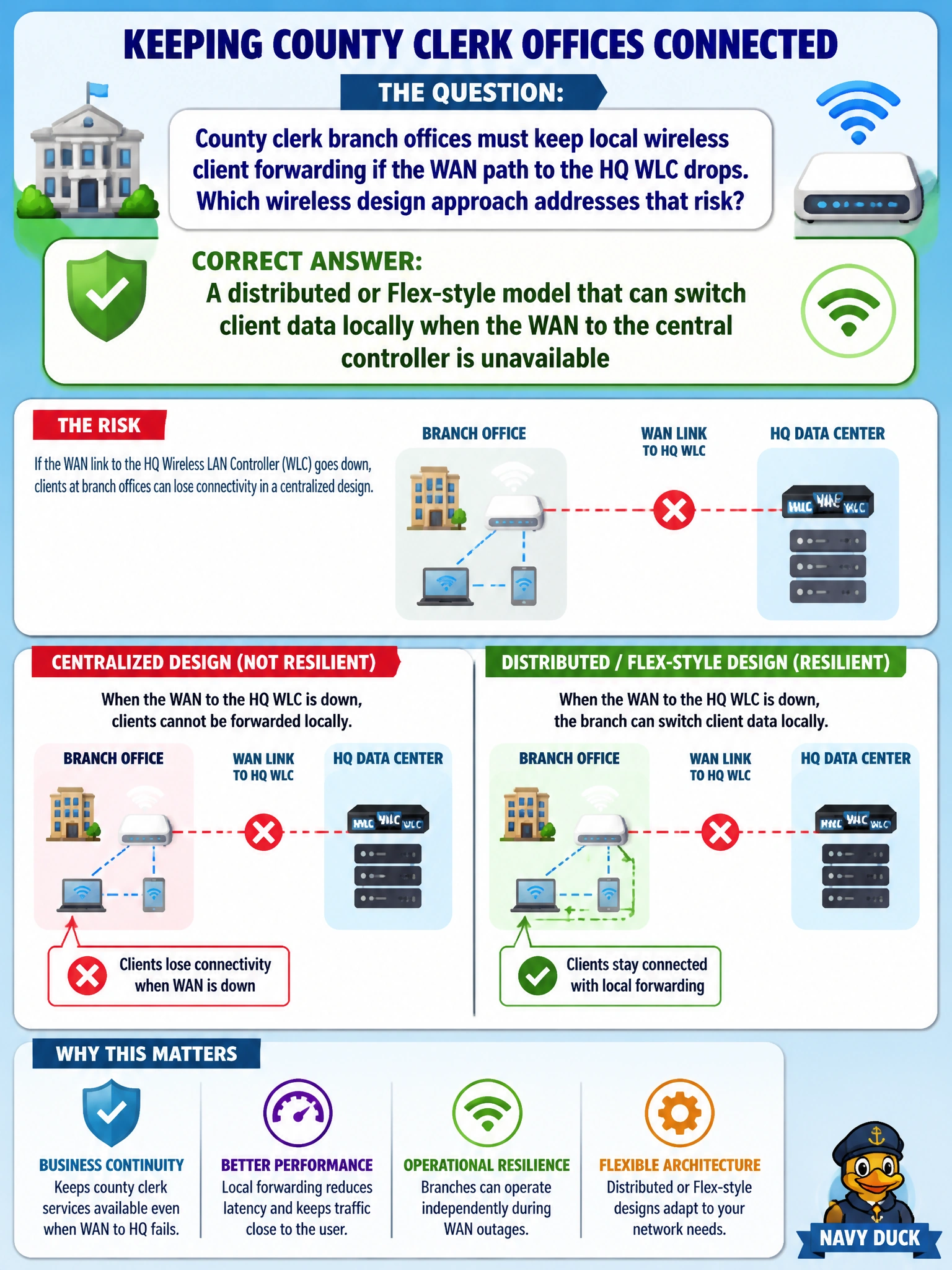
County clerk branch offices must keep local wireless client forwarding if the WAN path to the HQ WLC drops. Which wireless design approach addresses that risk?
Select an answer to reveal the explanation.
Short Explanation
If the WAN to HQ is a rickety ferry, don’t make every Wi-Fi click ride that ferry. Local switching (Flex-style) keeps branch traffic on-site when the controller link gets seasick.
Full Explanation
County clerk branch offices that must keep local wireless client forwarding if the WAN path to the HQ WLC drops need a distributed or Flex-style model that can switch client data locally when central controller reachability is impaired. Local switching preserves branch productivity for on-site printers, servers, and peer traffic even when CAPWAP or management reachability to HQ is down, which is a common municipal WAN risk for small clerk offices.
Centralized tunneling only, with all client data hard-dependent on continuous WAN reachability to HQ, fails exactly when the WAN drops. Disabling all local SSIDs whenever CAPWAP heartbeats miss one interval turns a transient WAN blip into a full wireless outage. Converting every branch AP into a wired-only hub that rejects 802.11 clients abandons wireless rather than solving WAN independence.
Exam caveat: Flex/local-switching questions test WAN survivability of the data plane, not whether a controller exists at all. Central policy can remain; local data switching is the resilience mechanism.
Operational check: configure and test Flex/local-switch WLANs at a clerk branch, fail the WAN toward HQ, and confirm clients still reach local resources while documenting which services still require central connectivity.