
A convention center is comparing controller-based wireless to a controller-less design for one large venue. What is a primary trade-off they should weigh?
Select an answer to reveal the explanation.
Short Explanation
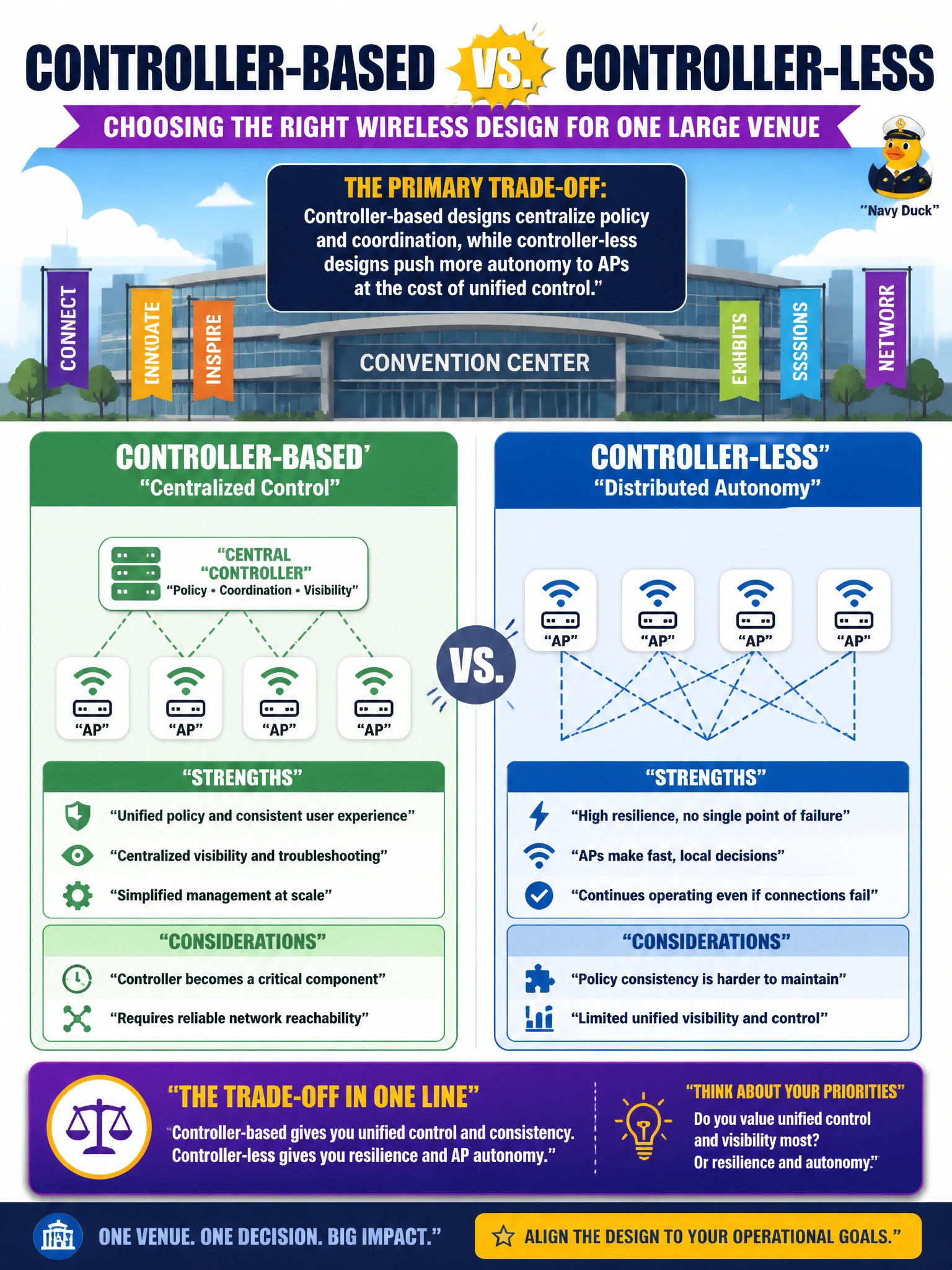
You can picture controller-based wireless as one conductor coordinating the orchestra, while controller-less APs play more independently. Centralized policy and coordination come with controller-based designs; with controller-less designs, you gain AP autonomy but give up unified control.
Full Explanation
For a large venue, the primary trade-off is centralized policy and coordination versus greater autonomy at the APs. Controller-based designs centralize policy and coordination, helping provide unified control across the venue; controller-less designs distribute more responsibility to APs, trading that unified control for local autonomy. The claim that controller-less designs always require MPLS underlays while controller-based designs forbid QoS describes an absolute dependency and prohibition that are not the defining trade-off. The claim that controller-based designs are limited to one AP while controller-less systems require dedicated supervisors for roaming clients also misstates the comparison: it substitutes unsupported scale and supervisor requirements for the actual difference in control. The claim that controller-less designs provide CoPP by default while controller-based designs remove all encryption likewise introduces unrelated security assertions rather than describing the design trade-off. Exam caveat: focus on centralized control versus AP autonomy, not MPLS, QoS, roaming supervisors, CoPP, or encryption. Practical check: determine whether venue operations need consistent, centrally coordinated policy across the APs; weigh that need against the greater local autonomy of a controller-less design.