
A school district wants centralized wireless LAN controller management across fifty campuses with consistent policy. Which wireless deployment model characteristic best matches that goal?
Select an answer to reveal the explanation.
Short Explanation
One district playbook, many gyms. Centralized WLC management is the coach with one rulebook—APs follow shared policy instead of freelancing fifty different SSIDs.
Full Explanation
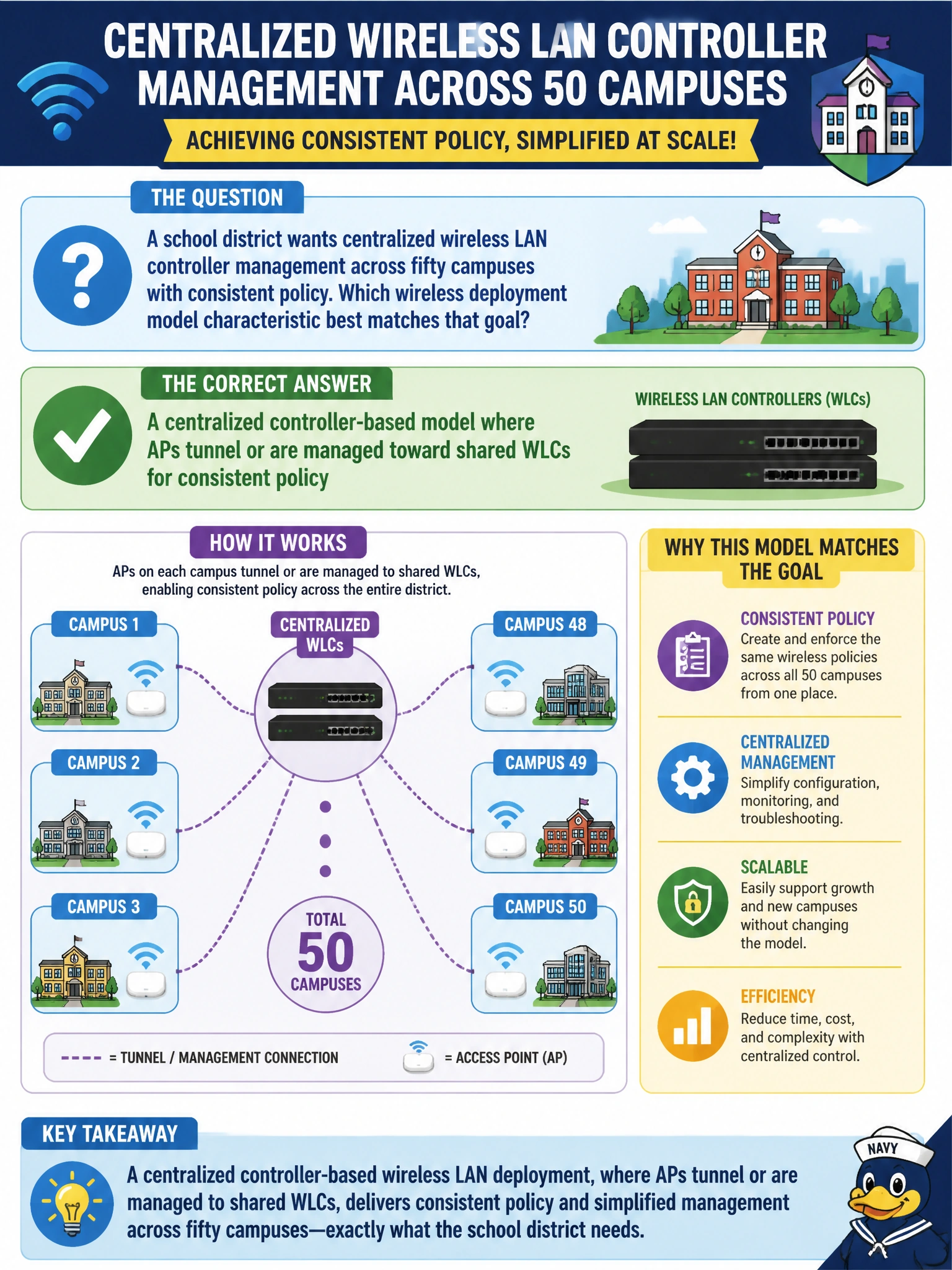
A school district that wants centralized wireless LAN controller management across fifty campuses with consistent policy is best matched by a centralized controller-based model where APs tunnel to or are managed by shared WLCs. Centralized control delivers uniform SSIDs, AAA/policy profiles, RF settings, and change control so every gym and classroom follows one district playbook rather than fifty local variants. That operational consistency is the defining characteristic for multi-campus municipal education deployments at ENCOR depth.
Every AP independently storing unique SSIDs with no shared controller policy is autonomous fragmentation, opposite of centralized consistency. Ad-hoc IBSS meshes between student laptops with no infrastructure APs are not an enterprise district WLAN model. Pure RF monitor mode on all APs offers no client data SSIDs and cannot serve instructional or administrative wireless.
Exam caveat: Centralized controller-based wireless is about shared policy and management scale—not a claim that APs have zero local function. Do not confuse monitor-mode or ad-hoc options with managed campus WLAN.
Operational check: confirm APs join the shared WLC(s), identical WLAN/policy profiles apply across campuses, and district change windows update SSIDs and security settings once centrally rather than per building.