
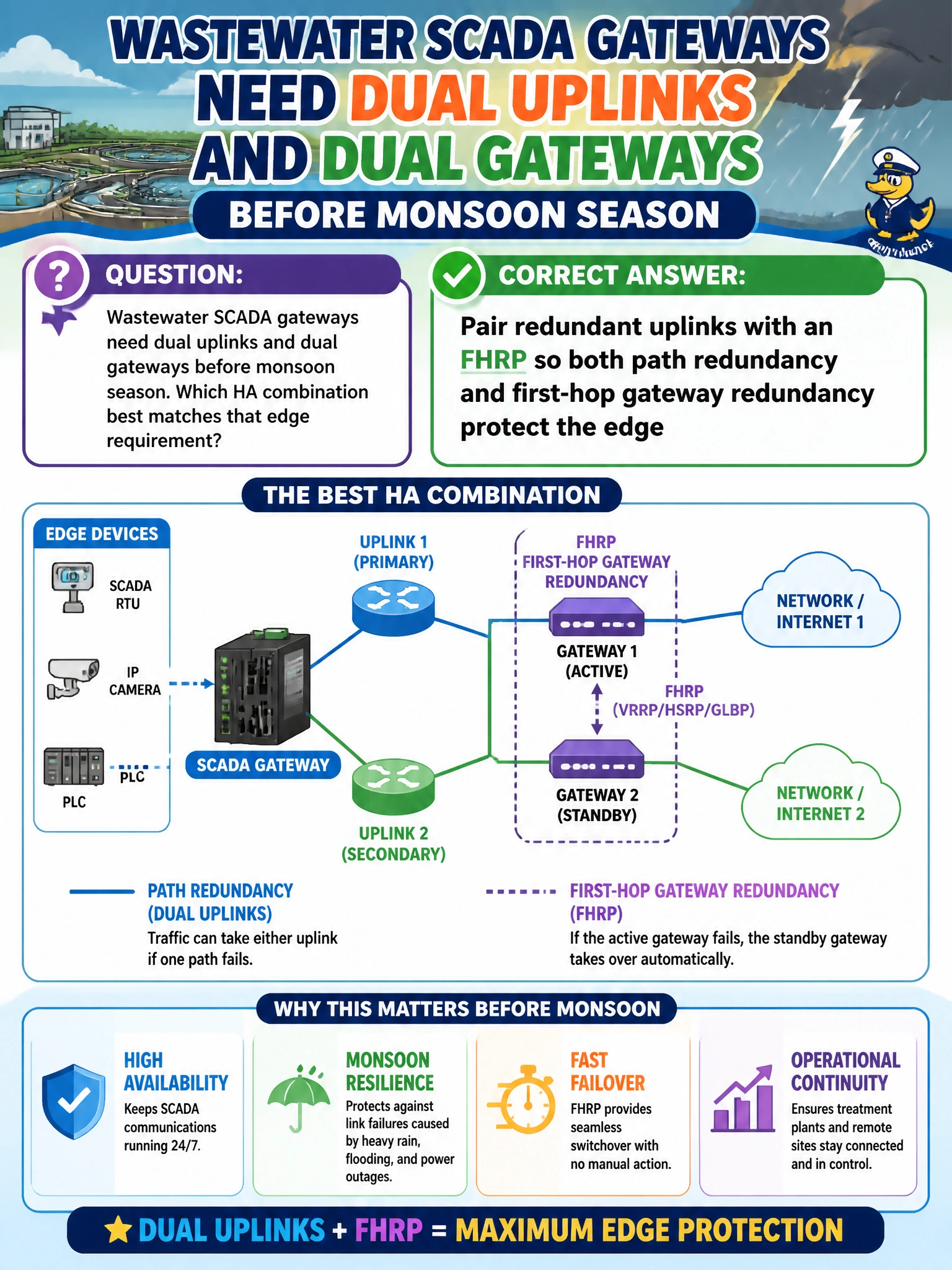
Wastewater SCADA gateways need dual uplinks and dual gateways before monsoon season. Which HA combination best matches that edge requirement?
Select an answer to reveal the explanation.
Short Explanation
Give the plant two roads out and two front-desk phones that share one number. Dual uplinks cover the roads; FHRP covers the shared gateway phone. Together they keep SCADA talking when monsoon weather knocks something over.
Full Explanation
Wastewater SCADA gateways that need dual uplinks and dual gateways before monsoon season are best protected by pairing redundant uplinks (path redundancy) with an FHRP (first-hop gateway redundancy). Dual uplinks give traffic another physical or logical path if a circuit or interface fails. FHRP keeps a stable virtual default gateway so SCADA hosts do not lose their next hop when the active gateway fails. Together they match the edge requirement for both path and gateway continuity under harsh seasonal conditions.
A single uplink with the default gateway disabled during storms removes both path and gateway protection. Relying only on CAM flooding after the primary gateway ARP ages out is not deterministic HA. Removing standby gateways and pinning every SCADA host to the STP blocked port actively places critical traffic on the wrong Layer 2 path and abandons FHRP.
Exam caveat: Edge HA stems often expect the combination of link redundancy plus FHRP—not one without the other—when both dual uplinks and dual gateways are stated requirements.
Operational check: verify dual uplinks are forwarding as designed (or fail over cleanly), FHRP tracks those uplinks, SCADA hosts use the VIP, and monsoon failure drills prove both path and gateway recovery for the wastewater plant.