
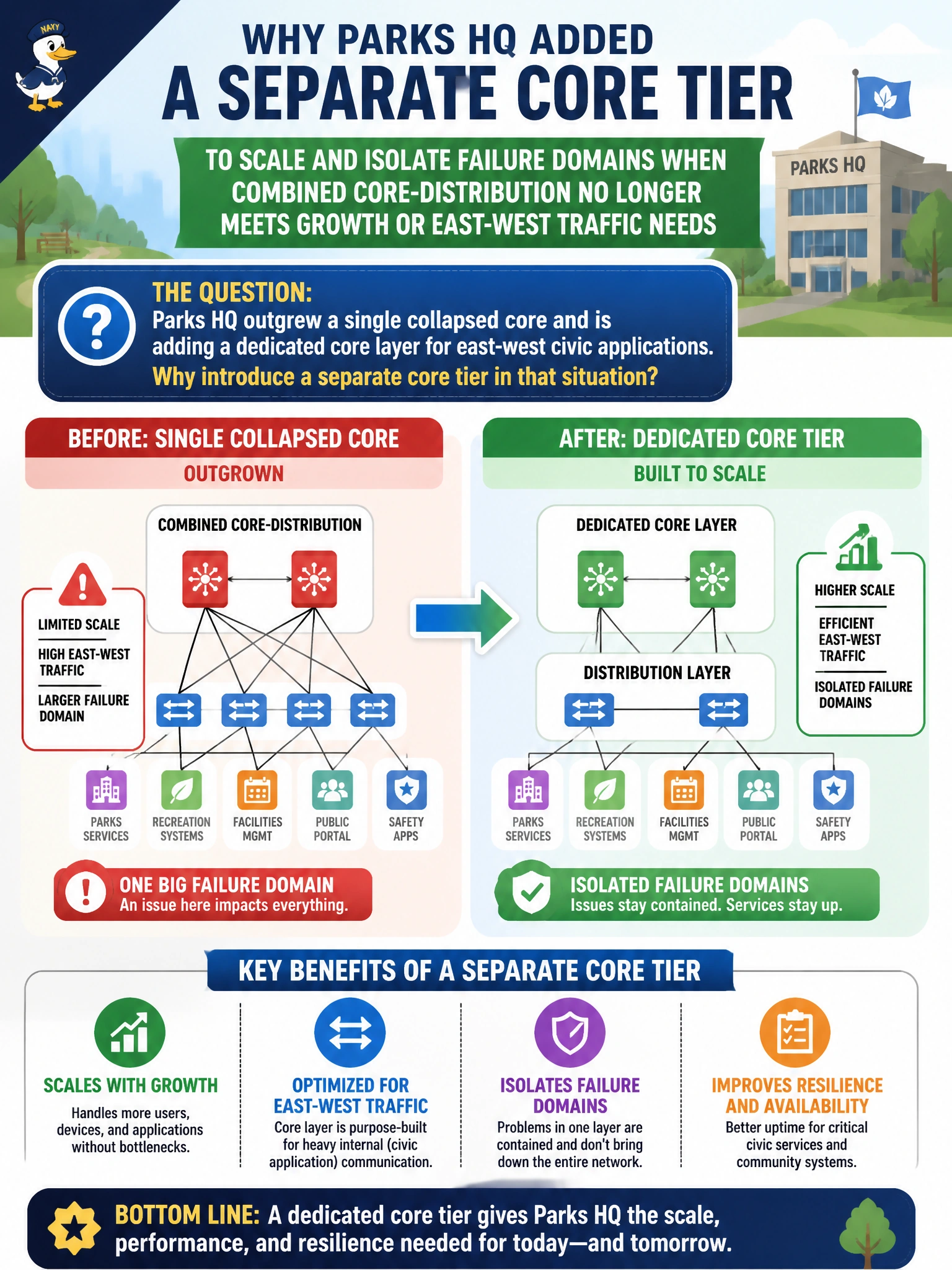
Parks HQ outgrew a single collapsed core and is adding a dedicated core layer for east-west civic applications. Why introduce a separate core tier in that situation?
Select an answer to reveal the explanation.
Short Explanation
When one combined core-distribution box becomes the town’s only intersection, every parade and every ambulance shares the same jam. A dedicated core is a new freeway spine that scales and keeps failures from taking out everything.
Full Explanation
Parks HQ that outgrew a single collapsed core introduces a dedicated core tier to scale bandwidth and isolate failure domains when combined core-distribution no longer meets growth or east-west civic application needs. Separating core from distribution creates a cleaner hierarchy: distribution aggregates access closets and policy edges, while the core provides high-speed, relatively policy-light transport between distribution blocks. That reduces the blast radius of a single combined-layer failure and supports heavier east-west flows between civic systems.
Replacing all FHRP groups with Spanning Tree root bridges on every access VLAN does not motivate a core tier and weakens first-hop design. Forcing every wireless AP into autonomous mode before distribution upgrades confuses WLAN mode with campus hierarchy. Shrinking underlay MTU so SD-WAN overlays no longer need encryption is unrelated and incorrect; MTU and encryption are not solved by inventing a smaller MTU to avoid crypto.
Exam caveat: Move from collapsed core to three-tier when scale, east-west demand, or failure isolation justify it—not because unrelated wireless or SD-WAN myths require it.
Operational check: measure east-west utilization through the collapsed layer, estimate growth from new parks applications, and decide whether a dedicated core reduces oversubscription and failure domain size enough to justify the added tier before the next civic expansion.