
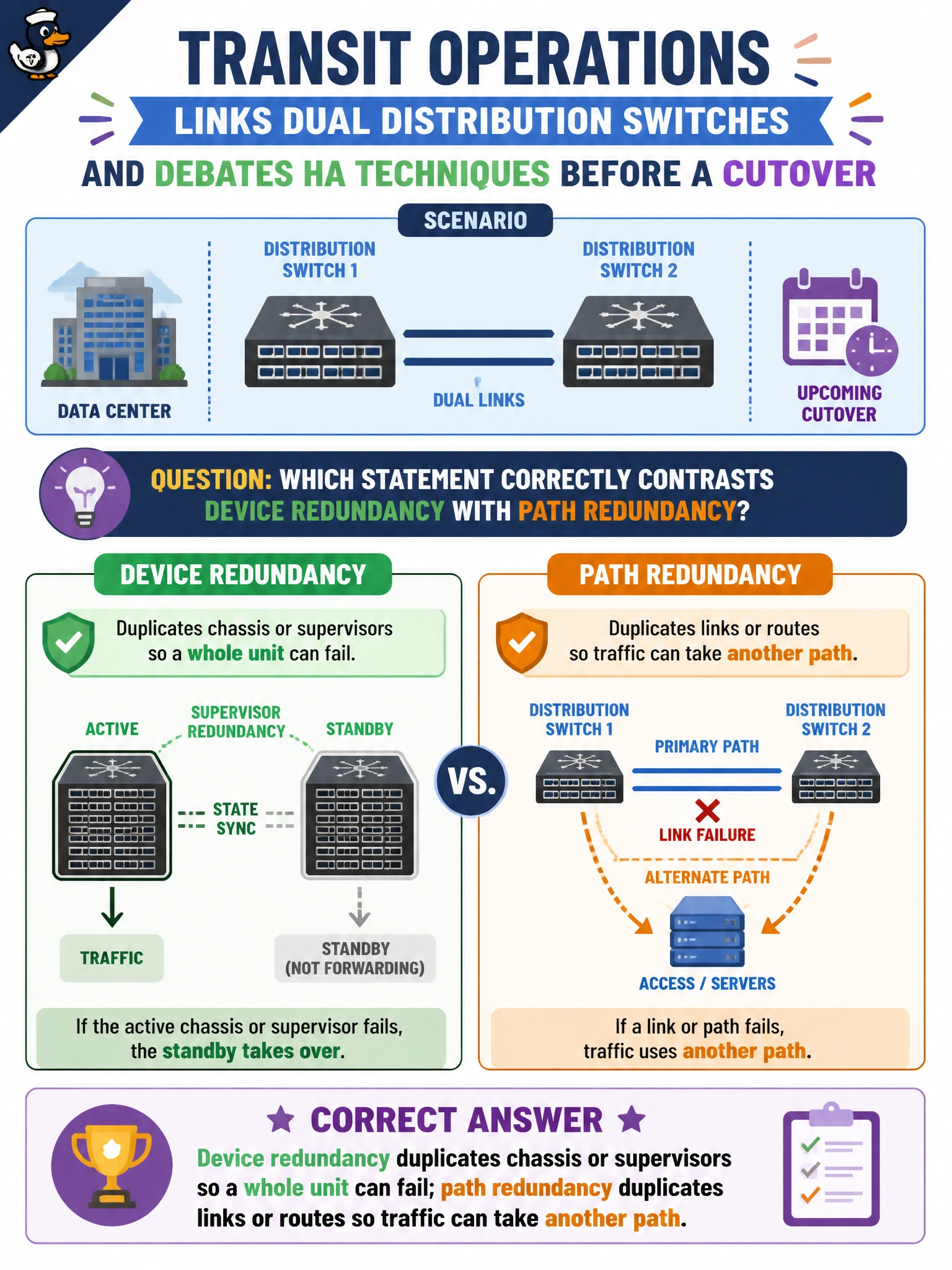
Transit operations links dual distribution switches and debates HA techniques before a cutover. Which statement correctly contrasts device redundancy with path redundancy?
Select an answer to reveal the explanation.
Short Explanation
Two fire trucks in the station is device redundancy; two different roads to the stadium is path redundancy. You often want both, but they solve different failure stories.
Full Explanation
Transit operations linking dual distribution switches must contrast device redundancy with path redundancy clearly. Device redundancy duplicates chassis, supervisors, or appliances so an entire unit can fail and another unit continues service. Path redundancy duplicates links, equal-cost routes, or alternate circuits so traffic can take another path when a link or intermediate hop fails. Municipal cutovers often need both, but they answer different failure stories: box failure versus path failure.
Saying device redundancy only adds extra fibers on one switch reverses the definitions—extra fibers are path redundancy—while claiming path redundancy only adds a second supervisor card likewise swaps the terms. Asserting that path redundancy eliminates any need for duplicate chassis, or that device redundancy eliminates all duplicate links, overstates exclusivity; designs commonly combine both. Claiming both terms mean identical EtherChannel hashes and never apply to municipal WANs is false on both counts.
Exam caveat: ENCOR HA vocabulary questions fail candidates who mix link/path redundancy with chassis/supervisor redundancy. Read which failure domain the stem emphasizes.
Operational check: for the transit cutover, map each risk—single chassis loss versus single fiber cut—then provision duplicate devices where box failure is unacceptable and duplicate uplinks/routes where path failure is the concern, and document which protection covers which municipal SLA.