
Police HQ dual-supervisor chassis must keep forwarding during control-plane failover. Which high-availability feature is intended to provide stateful switchover of the control plane rather than a cold reboot of the newly active supervisor?
Select an answer to reveal the explanation.
Short Explanation
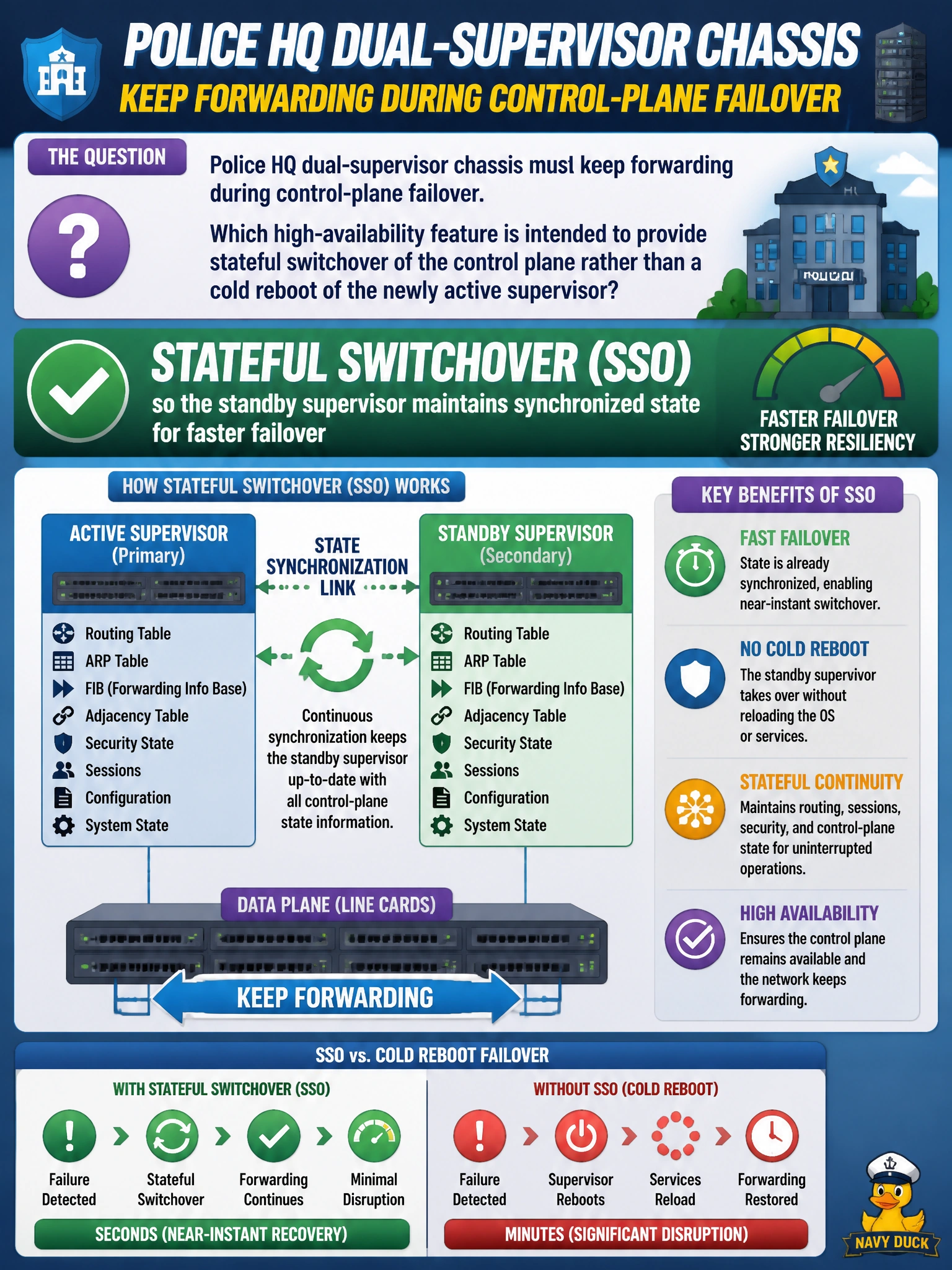
Picture two dispatch supervisors sharing one radio logbook in real time. SSO keeps that shared state warm, so when the active supervisor drops, you have a standby that is already caught up—not one cold-starting from a blank reboot.
Full Explanation
Police HQ’s dual-supervisor chassis relies on Stateful Switchover (SSO) to keep forwarding during control-plane failover. SSO synchronizes critical control-plane state to the standby supervisor, allowing it to take over and continue operations without a cold reboot and full state rebuild. Increasing BPDU Guard errdisable recovery on every access port addresses edge-port loop-guard recovery; it does not preserve supervisor state or provide control-plane failover. Using process switching so each packet runs through the newly active supervisor CPU after reload describes a performance and recovery anti-pattern, not stateful high availability. Disabling CEF so the standby builds adjacencies only after the first ARP request undermines hardware forwarding and delays forwarding; it is opposite to the goal of preserving forwarding through a switchover. Exam caveat: distinguish SSO, which provides stateful supervisor switchover, from access-port protection or cold-standby behavior. On a dual-supervisor platform, SSO is the control-plane high-availability feature sought here. Practical check: confirm SSO and the redundancy mode are configured, verify that the standby is hot and state synchronization is complete, then validate that supervisor failover preserves forwarding for critical dispatch VLANs without requiring a full cold reboot of the new active supervisor.