
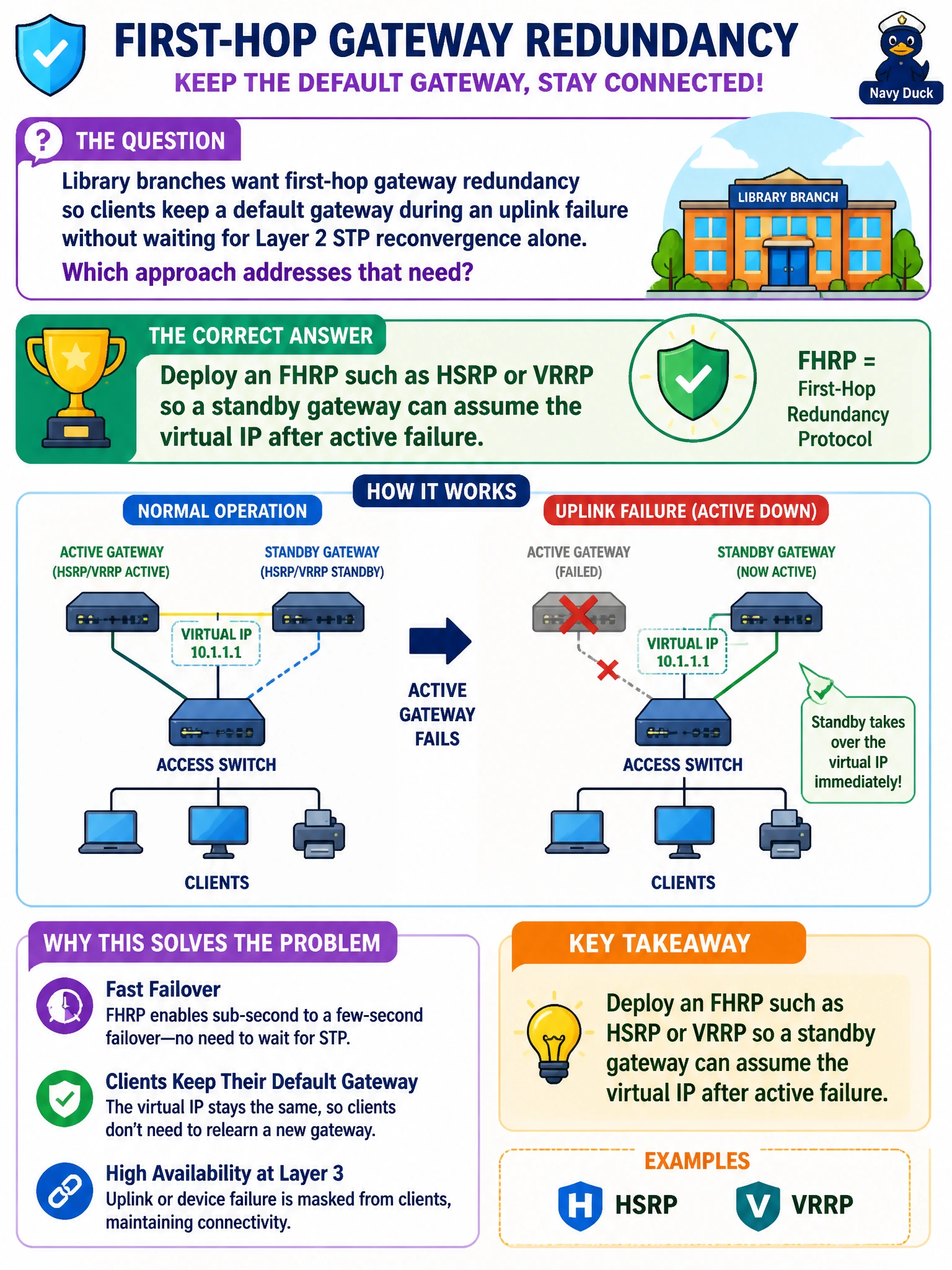
Library branches want first-hop gateway redundancy so clients keep a default gateway during an uplink failure without waiting for Layer 2 STP reconvergence alone. Which approach addresses that need?
Select an answer to reveal the explanation.
Short Explanation
Clients cling to one default-gateway IP like a front-desk phone number. FHRP keeps that number alive on a standby when the active desk fails—way faster than waiting for the whole Layer 2 spanning-tree drama to finish.
Full Explanation
Library branches that need first-hop gateway redundancy so clients keep a default gateway during uplink failure should deploy an FHRP such as HSRP or VRRP. Hosts continue to use a stable virtual IP and virtual MAC while a standby router or Layer 3 switch assumes the active role after failure. That protects against gateway device or uplink loss without depending solely on Layer 2 STP reconvergence, which does not provide an alternate gateway IP by itself and can leave hosts pointing at a dead next hop until ARP and topology converge awkwardly.
Increasing STP max-age only while keeping a single static default gateway on every PC delays topology change detection and still leaves a solitary gateway with no standby. Disabling first-hop redundancy and relying on CAM aging to move the gateway MAC is not a controlled HA design and does not give hosts a maintained virtual gateway. Replacing every access VLAN with a /32 host route advertised only during STP topology changes invents an operationally fragile mechanism that is not the ENCOR first-hop redundancy answer.
Exam caveat: FHRP solves default-gateway continuity; STP solves Layer 2 loop-free topology. Do not treat STP tuning as a substitute for HSRP/VRRP when the stem asks for gateway redundancy.
Operational check: verify FHRP group, VIP, and tracking of uplinks on library distribution pairs; confirm clients use the VIP as default gateway; test active failure and measure failover time versus STP-only behavior before go-live.