
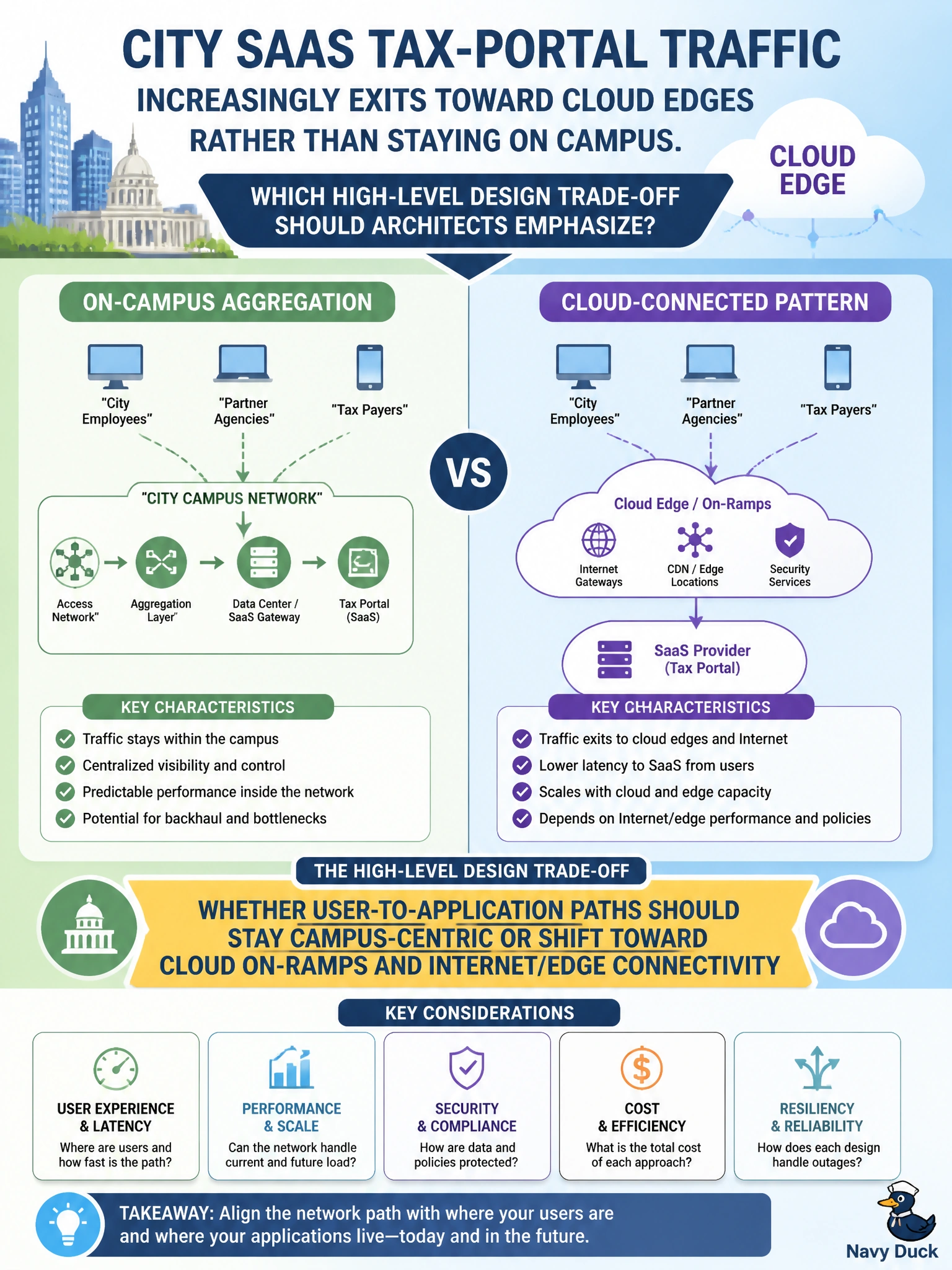
City SaaS tax-portal traffic increasingly exits toward cloud edges rather than staying on campus. Which high-level design trade-off should architects emphasize when comparing on-campus aggregation to a cloud-connected pattern?
Select an answer to reveal the explanation.
Short Explanation
If most clerks live in the cloud app all day, forcing every click back through the old campus core is like routing airport taxis through downtown forever. Design follows where the apps live—campus aggregation versus cloud on-ramps.
Full Explanation
When city SaaS tax-portal traffic increasingly exits toward cloud edges rather than remaining on campus, architects must emphasize whether user-to-application paths should stay campus-centric or shift toward cloud on-ramps and Internet/edge connectivity. Application gravity drives high-level design: if clerks spend the day in cloud SaaS, hairpinning every session through a traditional on-campus aggregation core adds latency, WAN cost, and brittle dependency on campus choke points that no longer host the application.
Whether Spanning Tree diameter can exceed seven hops inside a SaaS provider region is not a campus-versus-cloud aggregation trade-off and misplaces STP concerns into a provider domain you do not design. Matching HSRP preempt delay exactly to a cloud BGP hold timer mixes first-hop LAN HA with WAN/cloud routing timers incorrectly. Assuming TCAM ACL capacity on access switches grows automatically with each SaaS license invents a coupling that does not exist and ignores where policy should be enforced as paths move off campus.
Exam caveat: ENCOR design questions contrast campus-centric aggregation with cloud-connected patterns when apps leave the premises. The answer is path and aggregation strategy, not unrelated STP, FHRP, or TCAM trivia.
Operational check: measure where tax-portal sessions terminate, quantify hairpin traffic through the campus core, evaluate Direct Connect/ExpressRoute-style or secure Internet edge on-ramps, and redesign policy inspection and breakout so municipal users follow the applications rather than legacy campus gravity.