
An omnidirectional antenna on a high ceiling is replaced with a higher-gain omnidirectional antenna to reach the floor below. The floor below gets weaker. Why?
Select an answer to reveal the explanation.
Short Explanation
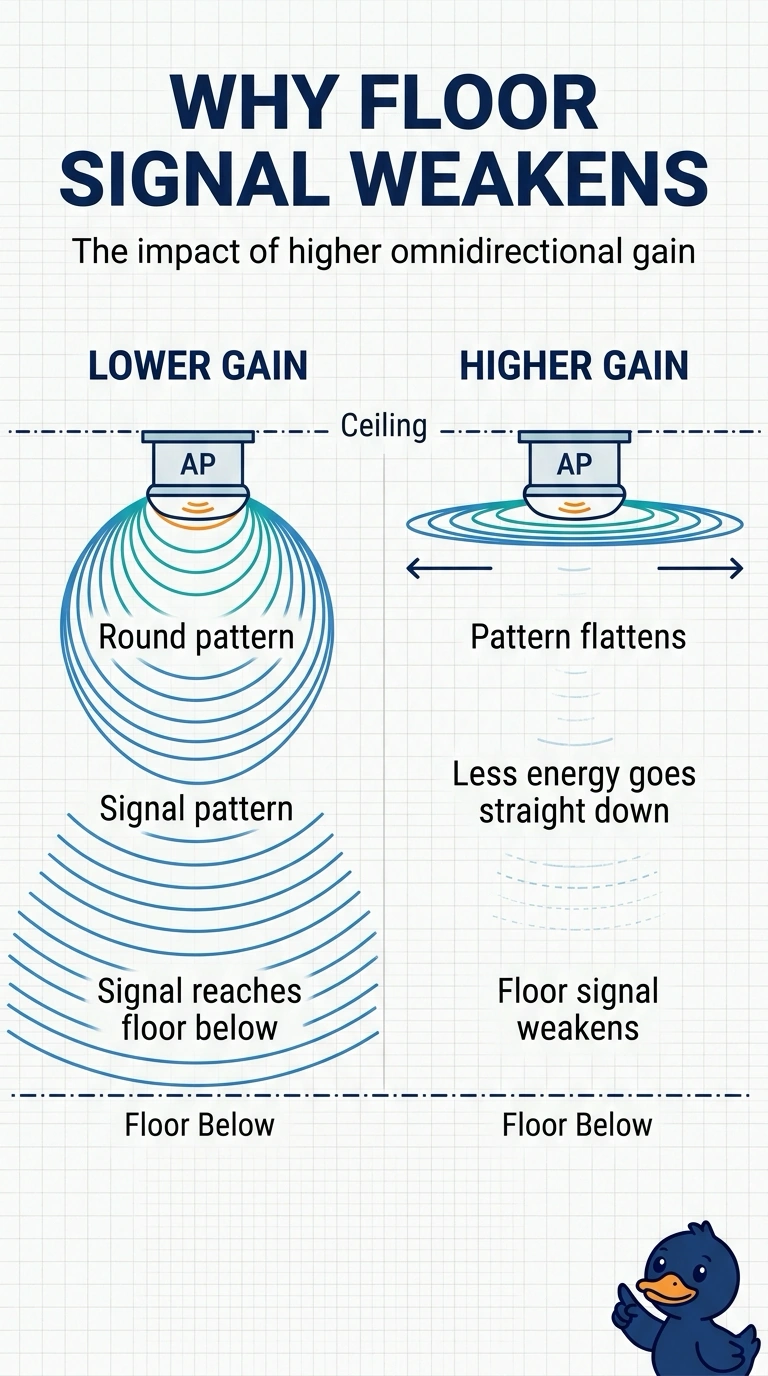
Gain does not brew new energy, and it does not aim an omni at the basement. You squeezed the pattern flatter, so the floor below, which sits off that disc, got less. The rooms out on the floor you already covered are the ones that got the extra.
Full Explanation
Passive gain concentrates power that the radio already produces. On an omnidirectional antenna, higher gain typically flattens the doughnut, putting more energy toward the horizon and less straight down. The floor below gets weaker because it sits outside that flatter pattern. Higher gain does not create a new downward beam. It also does not turn the omni into a directional antenna aimed at the floor below. You would need a different antenna and a deliberate aim for that. The country code does not mute a single floor. It limits radiated power for the regulatory domain. A higher-gain omnidirectional antenna flattens the pattern. It does not fill the floor below. The rooms under the access point get worse, not better. Exam caveat: a flatter pattern can overshoot into the neighbor's suite on the same floor. Survey the horizon as well as the floor below before you leave the higher-gain omni in place. Operational check: measure under the access point and out on the same floor, and confirm the new antenna is stronger on the floor and weaker directly below.