
A survey in an empty hangar measures a signal, then moves the laptop to twice the distance from the same access point with nothing in the way. About how much does free-space loss increase?
Select an answer to reveal the explanation.
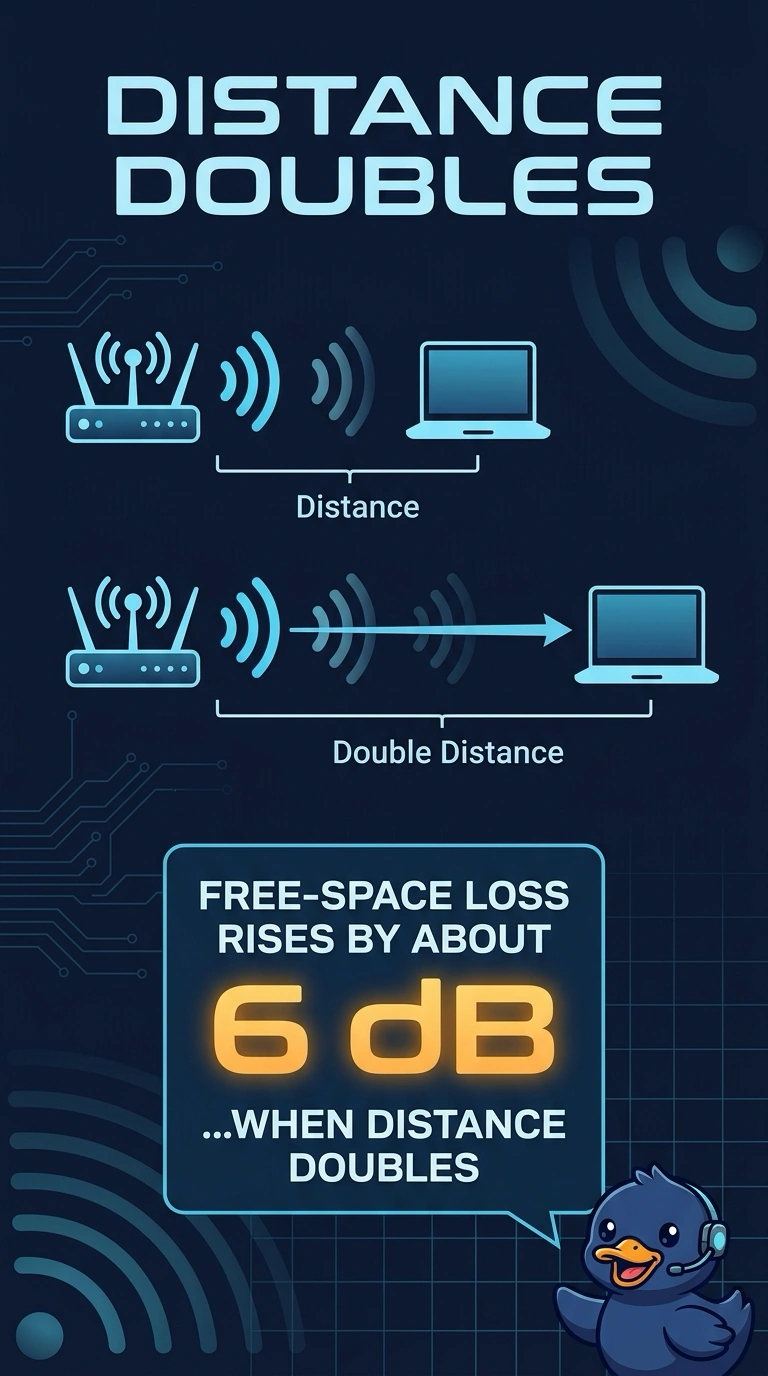
Short Explanation
Empty air still spends the signal as you walk away. Twice the distance is about another 6 dB of free-space loss, with nothing in the way. It is not a tenfold penalty, and the country code is not what spent it.
Full Explanation
Free-space path loss follows the distance. Doubling the distance increases that loss by about 6 dB, which is what the hangar measurement should show when nothing else is in the way. Three decibels is a halving of power, not the free-space cost of twice the distance. Ten decibels would be about a tenfold power change, and that is not what a doubled distance costs in free space. The country code does not set free-space loss. The same doubling costs about 6 dB in any country. In free space, doubling the distance costs about 6 dB. The client who moved twice as far did not lose half the power in a vague sense only. The rule is about 6 dB. Check one live client after the change and leave the rest of the floor alone until that client matches the result you expected. Exam caveat: the hangar is the clean case. A warehouse aisle adds walls, racks, and reflection, so a doubled distance there can cost more than 6 dB. Do not use the free-space number to predict a cluttered room. Operational check: measure at a distance and at twice that distance in the open hangar and expect the farther reading to be about 6 dB lower.