
Two hallway antennas are fed with the same conducted power. One is 6 dBi and the other is 9 dBi. How do they compare in the main lobe?
Select an answer to reveal the explanation.
Short Explanation
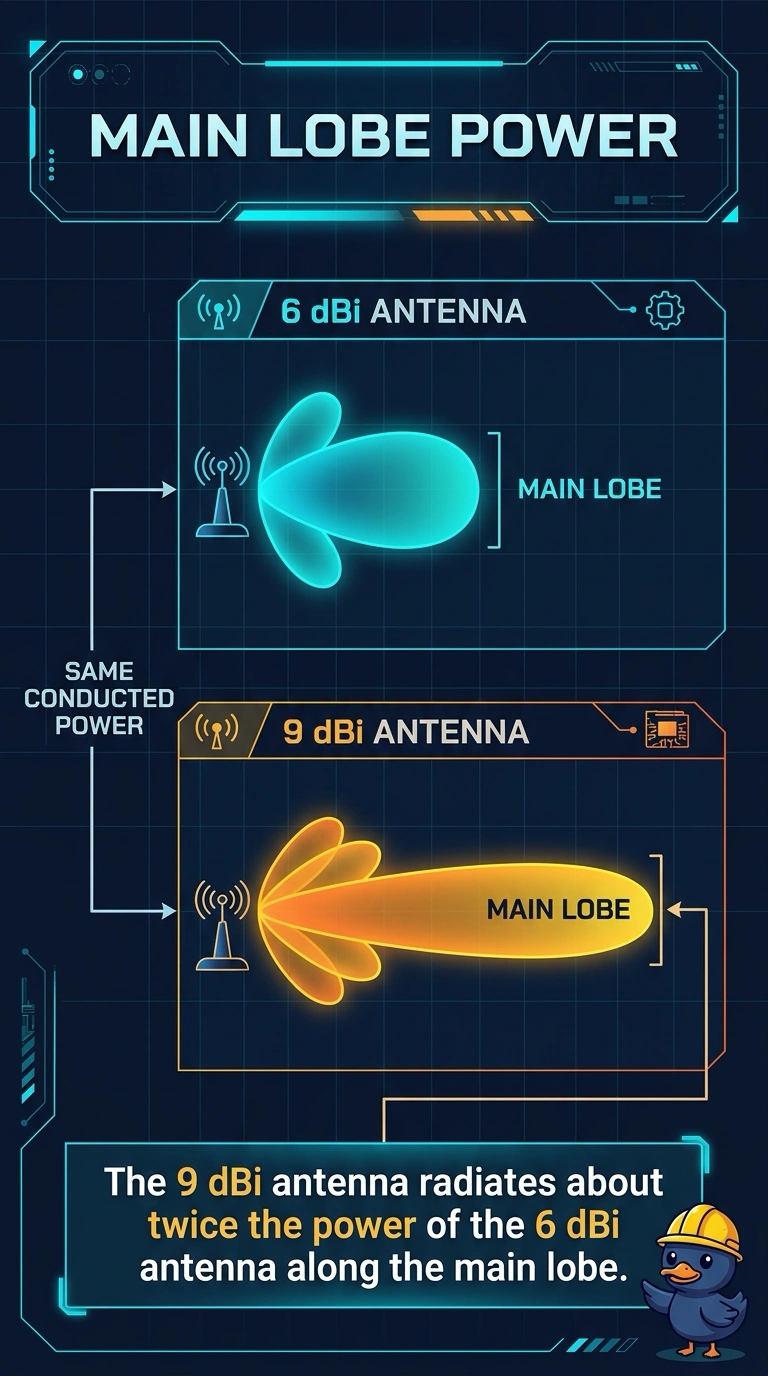
Three decibels is a doubling, and you have three decibels of gain between these antennas. The 9 dBi antenna puts about twice the power down the hallway from the same feed. The conducted number did not change, and the pattern did.
Full Explanation
Antenna gain is passive. It concentrates power. It does not create it. A 3 dB difference is about a factor of two, and 9 dBi is 3 dB above 6 dBi, so in the main lobe the 9 dBi antenna radiates about twice the power of the 6 dBi antenna when both are fed with the same conducted power. Ten times would be 10 dB, not 3 dB. A lower gain number is not a stronger lobe. 6 dBi concentrates less than 9 dBi. Equal conducted power does not mean equal radiation in the lobe. The higher-gain antenna is narrower and stronger on axis, and weaker off to the side. A 3 dB difference is about double the power in the main lobe. The feed did not change, and the higher-gain antenna is the one that concentrates it. Exam caveat: the twice-power claim is about the main lobe, not about every direction. A client off the side of the 9 dBi antenna can hear less than the same client heard from the 6 dBi antenna. Operational check: measure on axis at the same distance from each antenna and expect about 3 dB more from the 9 dBi antenna.