
A bank survey finds an access point that is not in the inventory and is beaconing the corporate SSID. The corporate radios show beacons from it on the same channel. What is it?
Select an answer to reveal the explanation.
Short Explanation
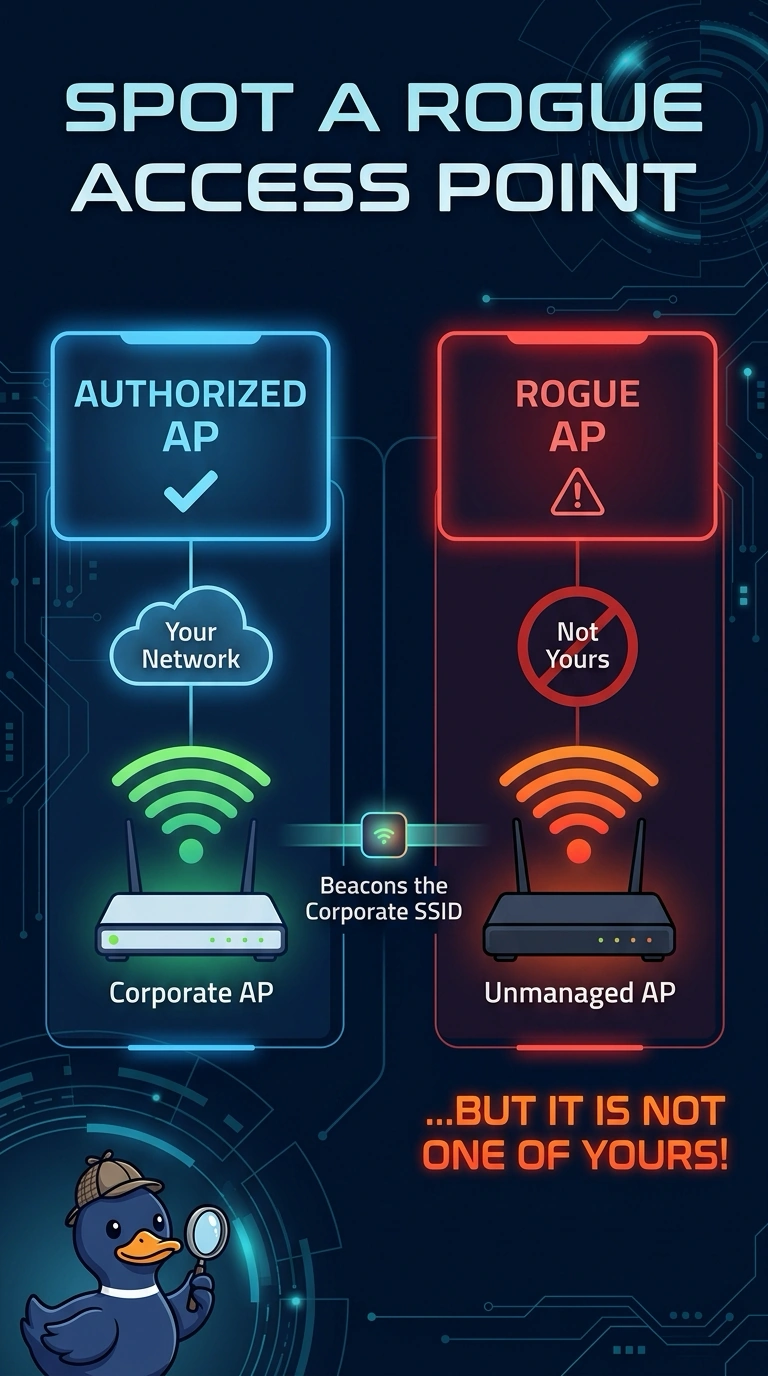
You’ve found an access point that uses your corporate SSID but isn’t in your inventory, so it’s a rogue access point, not static. Noise does not send beacons, and an extra beacon does not mean you have a coverage hole.
Full Explanation
A rogue access point is an access point that is not part of your network. This device is absent from your inventory and beacons the corporate SSID, while your corporate radios can see its beacons, so it is a Wi-Fi transmitter using your WLAN’s name. A noise source is non-Wi-Fi energy; it does not send beacons with an SSID. A coverage hole is an area where your own signal is too weak; an extra beacon from another device does not indicate a hole in your coverage. A DFS event is a reaction to radar detected on a 5 GHz channel; a beacon on the corporate channel does not mean radar was detected. Exam caveat: the corporate channel alone does not establish that a device is rogue; the relevant facts here are that it beacons your corporate SSID and is not in your inventory. Treat it through your rogue access point process, not as a noise-floor event. Practical check: locate the beaconing device, remove or contain it through that process, and confirm that your corporate radios no longer see its BSSID.