
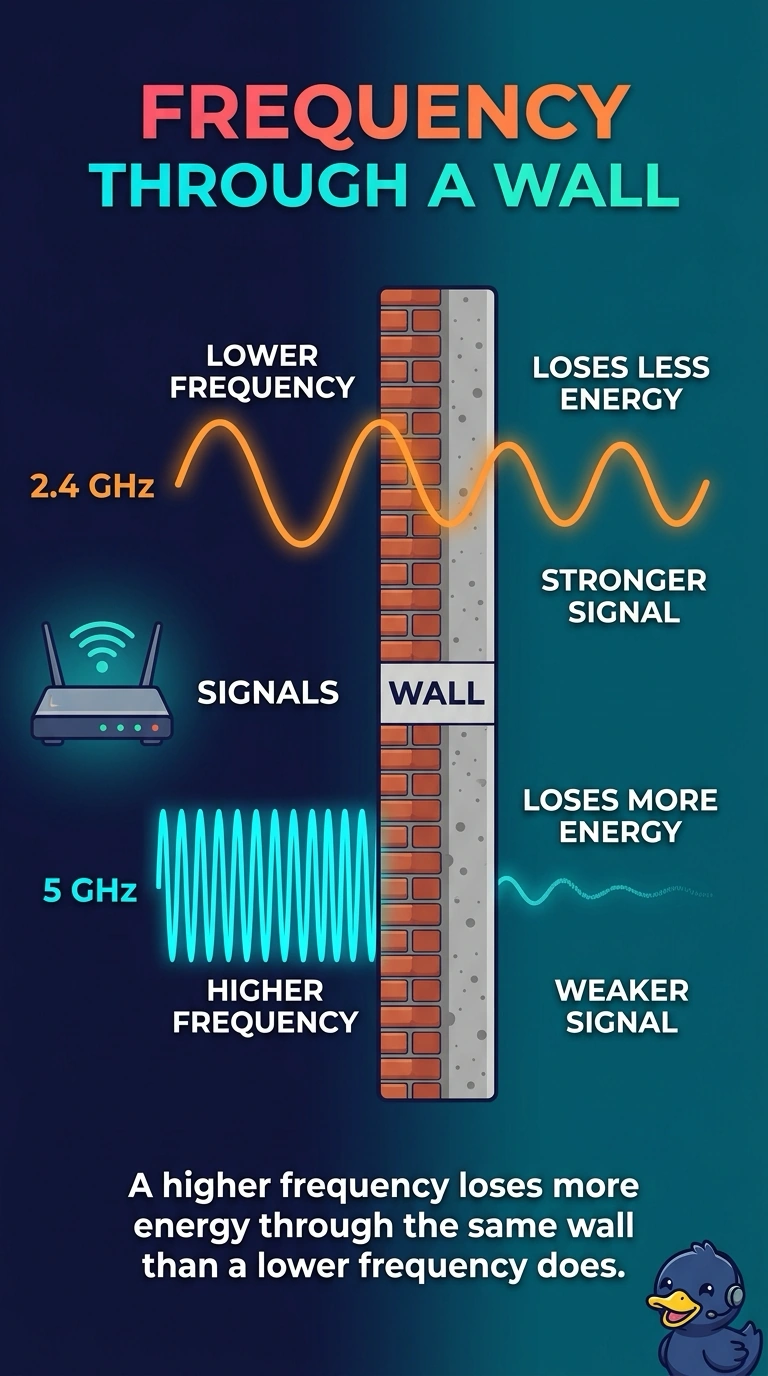
A stairwell is usable on 2.4 GHz and nearly dead on 5 GHz from the same access point through the same wall. What does that difference illustrate?
Select an answer to reveal the explanation.
Short Explanation
The same wall is a light coat for one band and a heavy coat for the other. Your 5 GHz signal is the one that gets used up in the stairwell. Higher frequency, more loss, through the same material.
Full Explanation
Absorption and other building loss go up as frequency goes up. The same access point through the same stairwell wall can leave a usable 2.4 GHz signal and a nearly dead 5 GHz signal, because the higher frequency loses more energy in that material. The claim that 5 GHz always travels farther through walls is the reverse of what this stairwell shows. A wall does not convert a band into a VLAN. The country code does not single out stairwells. It allows or denies channels for the whole regulatory domain, not for one room. The same stairwell wall is easy for 2.4 GHz and hard for 5 GHz. Higher frequency loses more through the same material. Check one live client after the change and do not retune the rest of the floor until that client matches the result you expected. Exam caveat: antenna aim and power still matter. A 5 GHz radio pointed the wrong way can look like wall loss. Here both bands come from the same access point through the same wall, which is the comparison that isolates frequency. Operational check: measure both bands at the stairwell landing and confirm 2.4 GHz remains usable where 5 GHz has fallen off.