
A campus path that looks short on a map crosses a row of trees and metal sculpture. The signal at the far bench is jumpy and weaker than the same distance across open lawn. Which effect are the trees and sculpture adding?
Select an answer to reveal the explanation.
Short Explanation
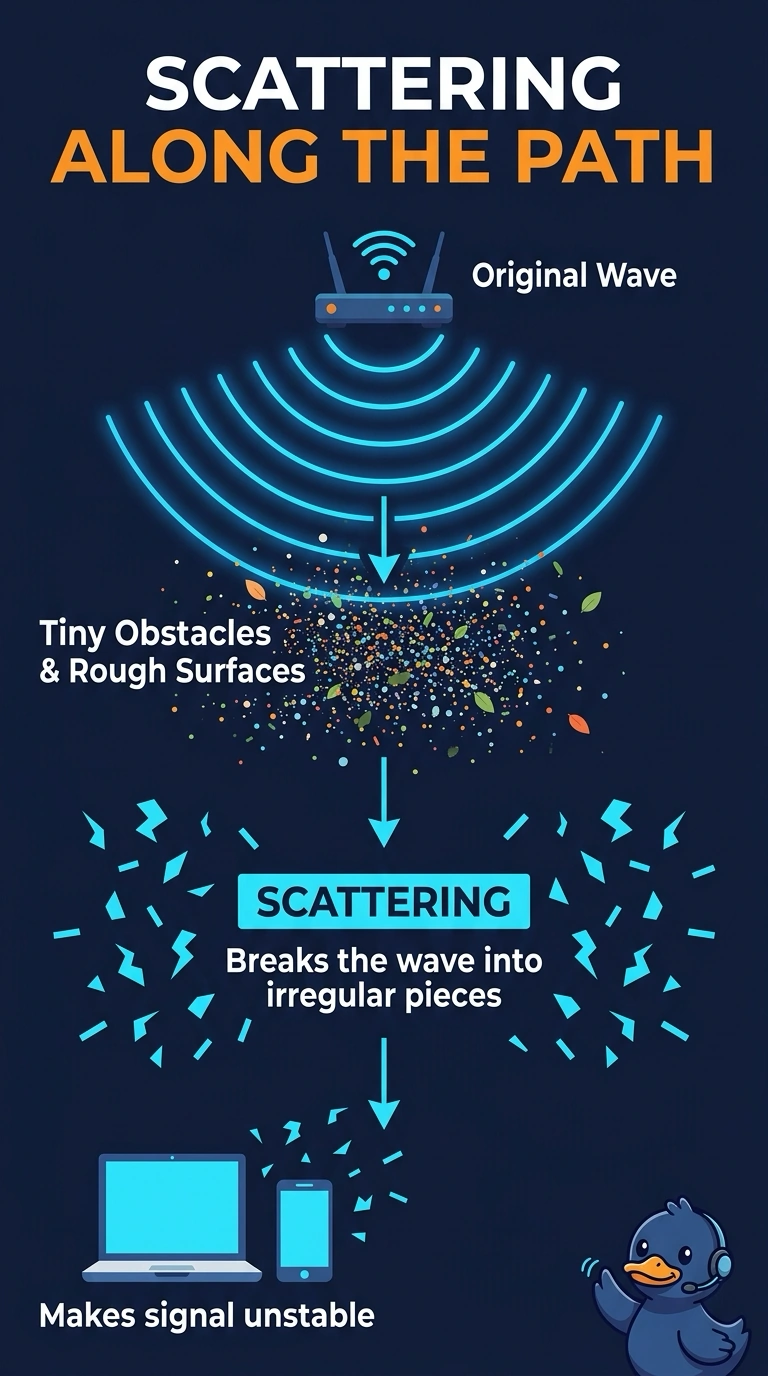
Open lawn is the clean path. Trees and sculpture chop the wave into messy pieces, so your bench is weaker and jumpy even though the map distance matches. That extra damage is scattering, not a VLAN.
Full Explanation
Scattering happens when a wave hits irregular objects smaller than a clean flat reflector, such as foliage and complicated metal shapes. Energy is thrown in many directions, so a path that looks short on a map arrives weaker and less stable than the same distance over open lawn. The trees and sculpture are adding scattering on top of ordinary distance loss. Free-space loss would treat both paths as open. It would not make the lawn, which is the open path, the weaker of the two. The observation is the opposite: the cluttered path is worse. A VLAN mismatch does not scatter RF, and an odd VLAN ID has no effect on a bench reading. A certificate error fails authentication. It does not change a signal measurement, and a valid date makes that distractor even less relevant. Exam caveat: scattering plus a moving person or a wet tree can swing a link that looked fine in a dry, empty survey. Survey the path the way people actually use it. Operational check: measure the bench and the open lawn at the same distance, with the same client, and confirm the cluttered reading is the unstable one.