
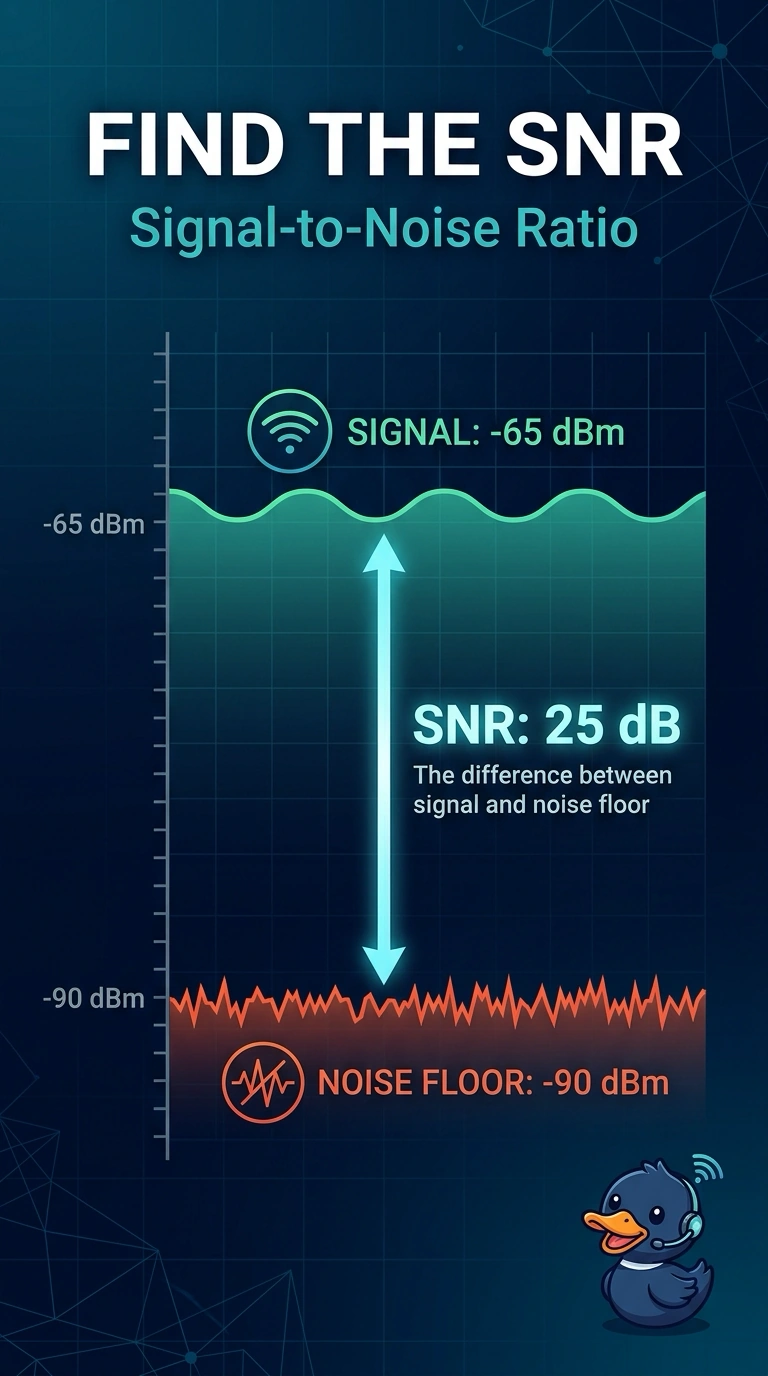
A handheld shows a received signal of -65 dBm and a noise floor of -90 dBm. What is the SNR?
Select an answer to reveal the explanation.
Short Explanation
SNR is how far the signal stands above the noise, and you subtract. Minus 65 minus a noise floor of minus 90 is 25 dB. Adding the two dBm readings, or dropping a sign, is a different number.
Full Explanation
SNR is the received signal minus the noise floor. Subtracting a negative noise floor is addition of its magnitude: -65 minus -90 equals 25. The unit of that difference is dB, not dBm, because it is a ratio between two powers rather than a power of its own. The handheld's SNR is 25 dB. Adding -65 and -90 produces -155, which would be a meaningless stacked power, not a gap. Calling SNR another name for the received signal ignores the noise entirely. A -65 dBm signal over a loud noise floor is a poor SNR, and a -65 dBm signal over a quiet floor is a good one. The signal number alone is not the SNR. Taking 90 from the noise floor and dropping the sign reports the noise, not the gap. The noise is 25 dB below the signal, so the SNR is 25 dB, not 90. Exam caveat: both numbers have to be in the same unit before you subtract. A vendor RSSI index and a dBm noise floor are not a valid SNR until you convert them. Operational check: read signal and noise in dBm from the same client detail and confirm the displayed SNR matches signal minus noise.