
A logistics bridge aims a directional antenna at a far building. One antenna is mounted vertical and the other horizontal. The link is much weaker than the same antennas aligned the same way. What is wrong?
Select an answer to reveal the explanation.
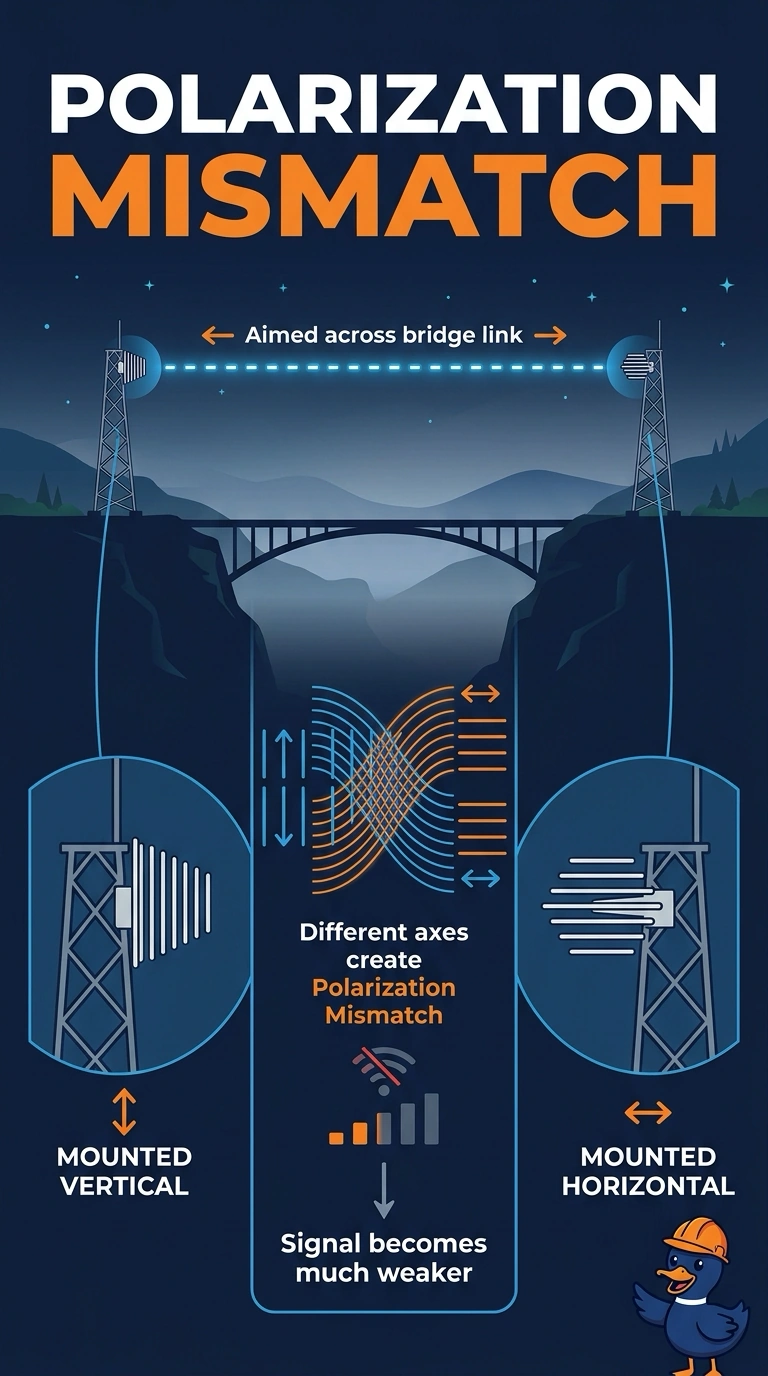
Short Explanation
The two antennas are turned like a handshake where one palm is sideways. Polarization mismatch throws away a big share of the link even when the aim is right. Your VLAN has nothing to do with which way the elements point.
Full Explanation
Polarization is the orientation of the wave. A link couples best when both antennas share that orientation. Mounting one vertical and one horizontal is a polarization mismatch, and the received signal drops sharply compared with the same pair aligned together. The aim can be correct and the link still looks weak. A VLAN mismatch affects whether frames are accepted on a port or a WLAN. It does not change radiated power when an antenna is rotated, and this symptom showed up when the mounting changed, not when a VLAN changed. DHCP gives clients addresses. It does not detune an antenna or select a polarization. A certificate mismatch breaks a secure join or an EAP exchange. It does not rotate an electric field, and a bridge antenna's orientation is a physical mount. Exam caveat: a small mounting error matters more on a long directional link than on a ceiling omnidirectional antenna in a carpeted office. Check the mount before you raise power and run into an EIRP limit. Operational check: rotate the far antenna to match the near one, leave the aim and the power alone, and confirm the received signal recovers.