
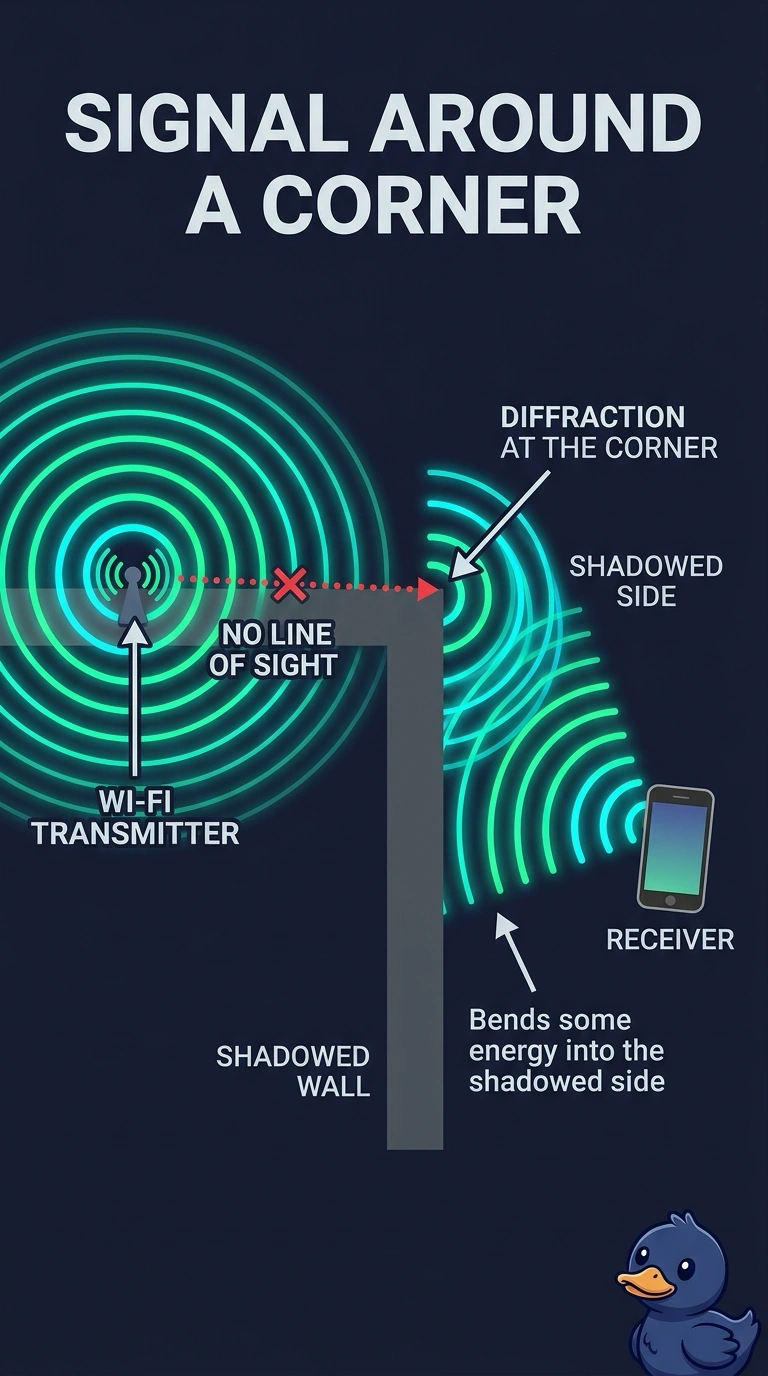
A logistics client stands around a concrete corner with no line of sight to the access point and still hears a weak signal that fades as they move deeper behind the corner. Which propagation effect is filling in that shadow?
Select an answer to reveal the explanation.
Short Explanation
The corner is not a perfect wall for radio. Some energy bends at the edge and leaks into the shadow, which is diffraction, and it gets weaker as you walk deeper in. A VLAN mismatch does not bend a wave.
Full Explanation
Diffraction is the bending of a wave around an edge. A client with no line of sight can still hear a weak signal because some energy diffracts at the corner into the shadow, and that fill-in fades as the client moves farther behind the obstacle. That matches the aisle. A VLAN mismatch drops or mis-forwards frames on a network. It does not bend RF around concrete, and the client is hearing a signal, not failing a VLAN check. Free-space loss describes spreading over distance in an unobstructed path. It does not add energy as someone walks deeper into a shadow. Deeper in the shadow should be weaker, which is what they observed, and free-space alone would not put energy behind the corner in the first place. A certificate mismatch affects authentication or join security. It does not scatter beacons into an aisle. Exam caveat: diffraction fill is not a design you should count on for voice. A client that only works on diffracted energy is a coverage hole waiting for a body or a cart to close it. Operational check: measure at the corner and several steps deeper, and confirm the weak signal tracks the edge rather than a second access point you have not inventoried.