
A lecture-hall access point is a four-stream radio. A tablet with a single radio chain never reaches the four-stream data rate, even when it sits next to the access point at high SNR. What limits the rate?
Select an answer to reveal the explanation.
Short Explanation
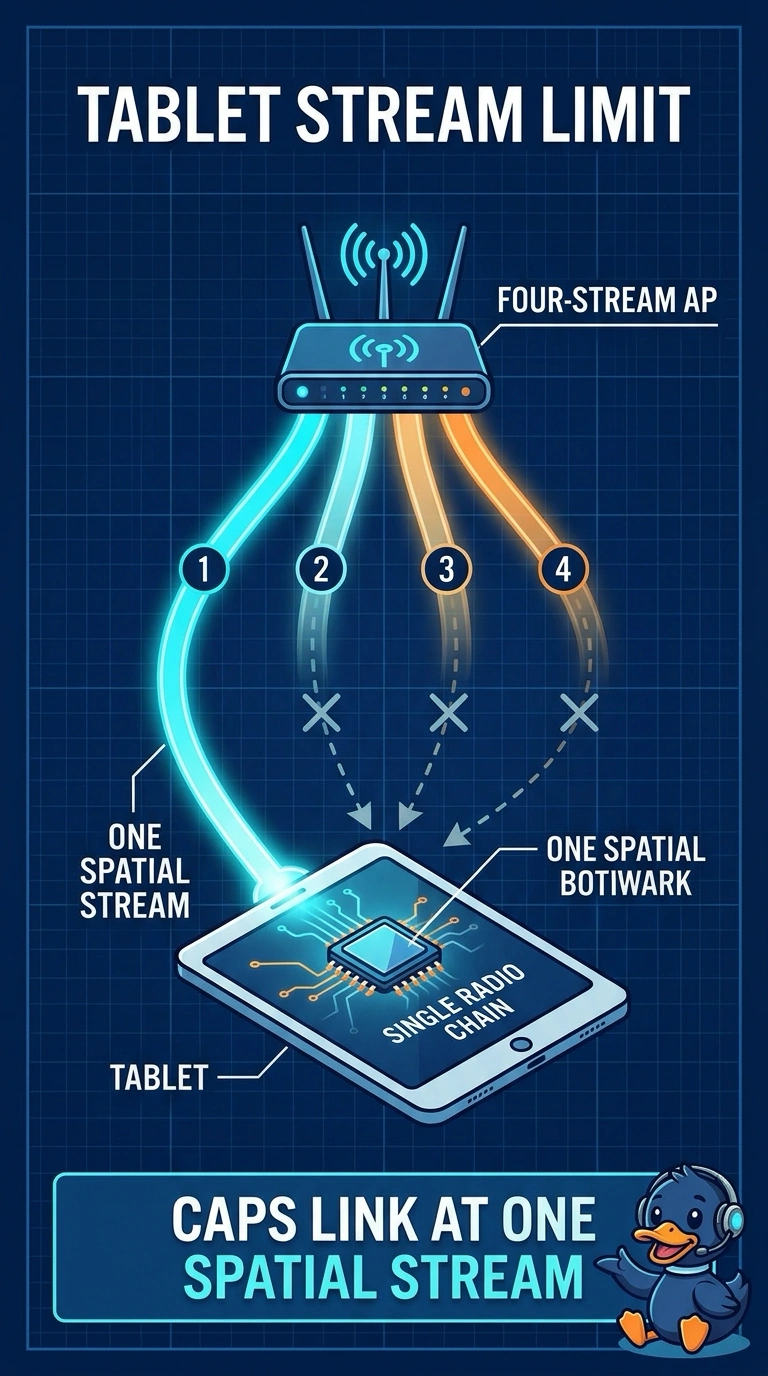
You’ve found the key limit: the tablet’s single chain supports only one spatial stream, even beside a four-stream access point. A strong signal cannot add radio chains to your tablet, and a DHCP lease does not choose its stream count.
Full Explanation
A spatial stream requires a radio chain at both ends of the link. The four-stream access point can provide high rates to clients with multiple chains, but the tablet’s single chain caps its link at one spatial stream, regardless of how strong the signal is beside the access point. The access point country code sets legal channels and power; it does not limit four-stream rates to tablets or change the tablet’s capability. The DHCP lease assigns network configuration and does not negotiate spatial streams, which are a radio capability exchanged at association. A hidden SSID omits the network name from beacons; it does not disable extra streams, and the tablet would still use one stream on a visible network. Exam caveat: a two-chain laptop in the same seat can achieve a higher rate without any access-point change. Do not redesign the channel plan to address a one-stream client. Practical check: read the client’s capabilities and negotiated stream count on the controller, then compare them with a multi-chain laptop in the same seat.