
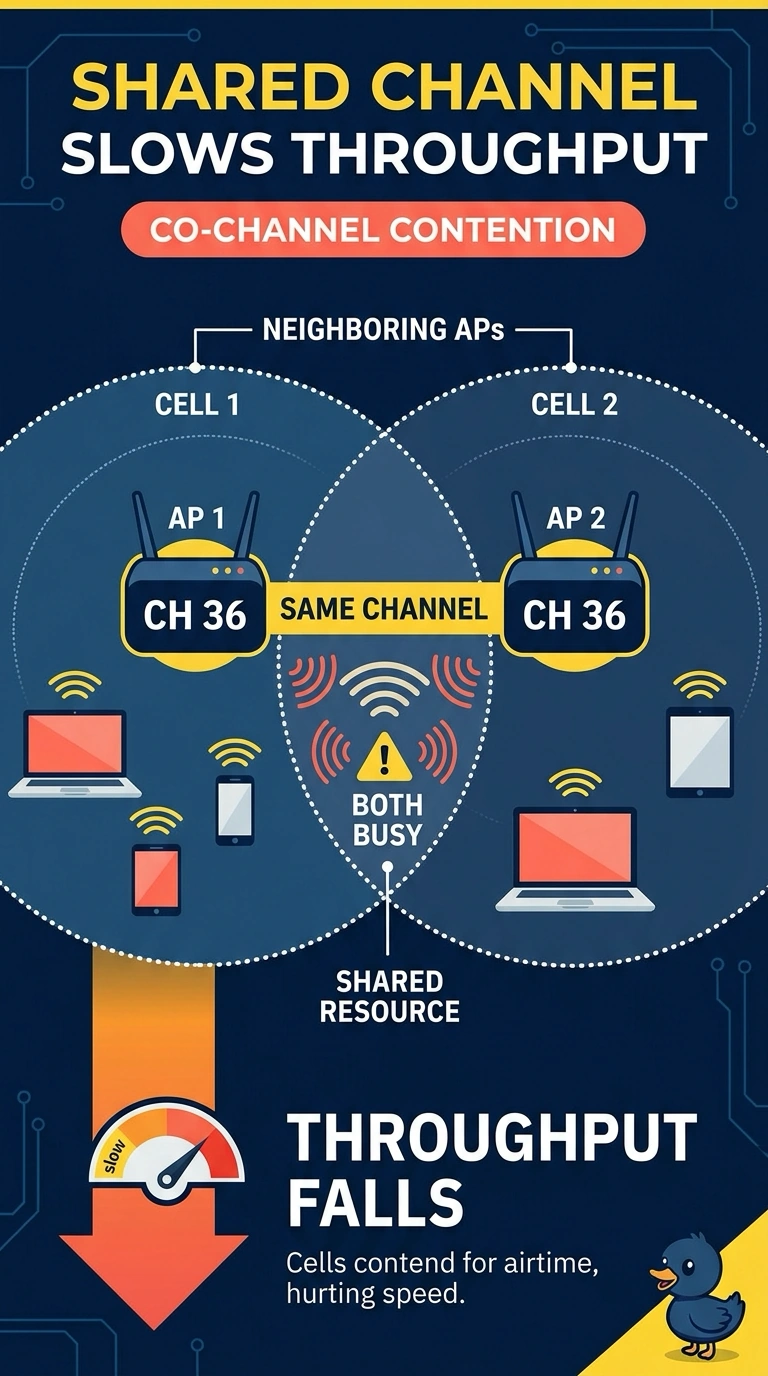
Two neighboring hospital access points are both on the same channel. Client SNR looks healthy, and throughput falls whenever both cells are busy. What is hurting throughput?
Select an answer to reveal the explanation.
Short Explanation
Your healthy SNR shows clients can hear the signal; they’re waiting for airtime, not struggling to hear. Because both access points share one channel, they take turns, so busy periods create co-channel contention. Fixing a certificate won’t add airtime.
Full Explanation
When two neighboring access points use the same channel, they create co-channel contention: they defer to one another’s transmissions, sharing the available airtime. Clients can still show healthy SNR, meaning the signal is well above the noise, yet experience poor throughput when both cells are busy. The load-related slowdown points to shared airtime, not a weak signal. A dead DHCP scope would leave clients without addresses; here, clients are moving data and slowing down as both cells become busy, so missing leases do not explain the symptom. Polarization mismatch causes signal loss from antenna orientation on a link; it does not make two infrastructure access points on one channel cancel every client, and a symptom that tracks load is not explained by antenna mounting. An expired certificate can prevent new access points from joining, but it does not create airtime contention between access points already serving clients. Exam caveat: increasing transmit power on a co-channel pair can worsen overlap rather than improve throughput. A practical check is to confirm both radios use the same channel and that channel utilization rises when both neighborhoods are busy, while SNR remains healthy.