
A university raises the lowest mandatory data rate on a residence WLAN. Students near the access points stay connected, and students at the edge of the same rooms can no longer associate. Why did the edge fail?
Select an answer to reveal the explanation.
Short Explanation
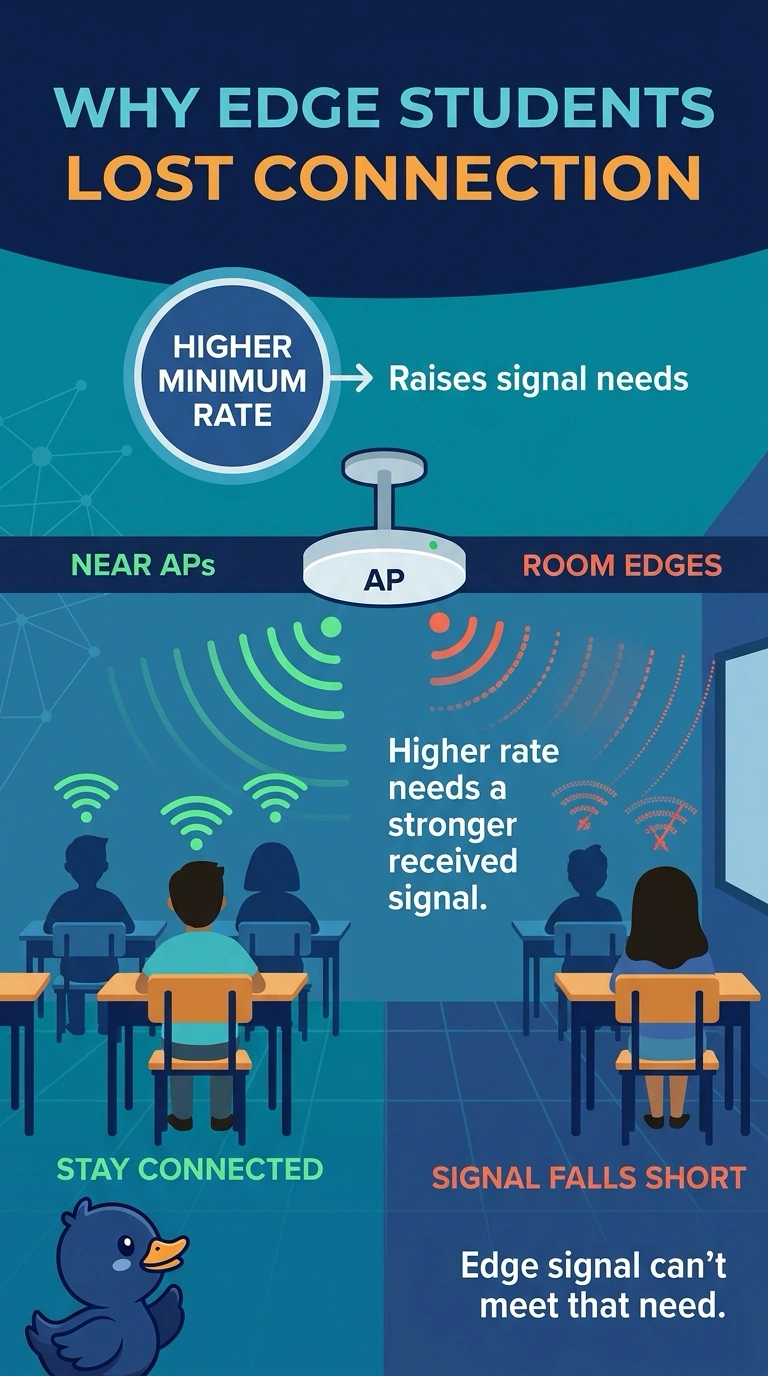
A higher mandatory rate is a stricter hearing test, not a bigger voice. Your edge students could still hear the access point well enough for a slow rate, and they cannot meet the louder bar you just set. DHCP did not move when you changed the rate.
Full Explanation
Receive sensitivity is the weakest signal at which a radio can still demodulate a given rate, and higher rates need a stronger signal and a cleaner SNR. Making a higher rate mandatory tells clients they must be able to speak and hear at that rate to use the BSS. Students near the access point still have that signal. Students at the edge do not, so they can no longer associate even though the access point did not move. DHCP is not disabled by a data-rate setting, and it is not limited to a distance. The edge failure happens at association, before an address is the issue. The country code is a regulatory configuration. Changing a mandatory rate does not rewrite it. Beacons continue to advertise the BSS, including the basic-rate set. They do not pause until a client transmits at the new rate. If beacons had stopped, the nearby students would have failed too. Exam caveat: raising basic rates can be a real design tool to shrink sticky cells, and it will also drop legitimate edge clients if you did not survey them at the new rate. Operational check: read the RSSI of a failing edge client and compare it with a client that still holds the mandatory rate in the same room.