
A stadium survey with a laptop shows a healthy downlink, but phones in the same seats keep failing while the laptop still works. The phones transmit at lower power than the access point. What is the limit?
Select an answer to reveal the explanation.
Short Explanation
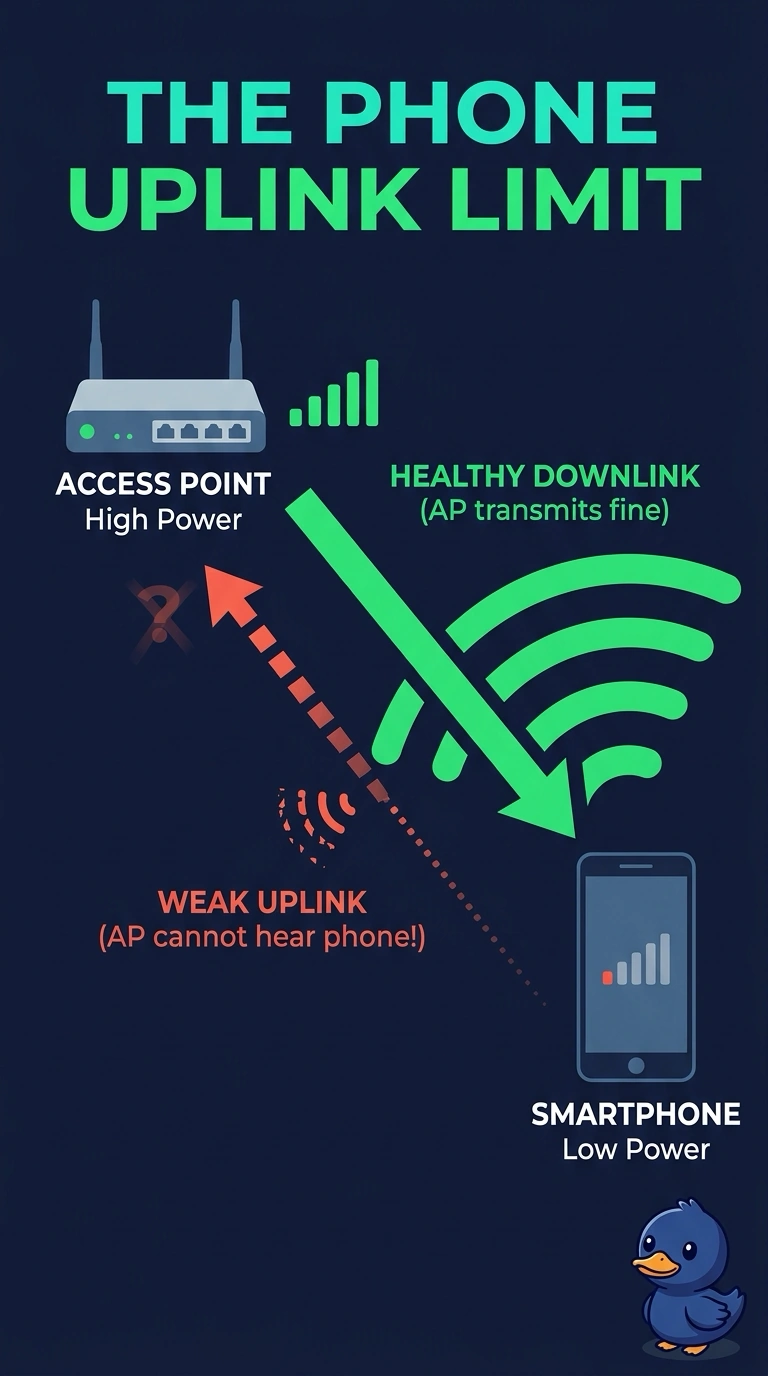
Think of the access point as having a loud voice and your phone as having a small one. Your laptop survey can hear the access point’s downlink without showing whether the access point can hear your phone’s weaker uplink. Turning up access-point power makes its signal louder, but does not make your phone transmit more strongly.
Full Explanation
Client devices, especially phones, usually have fewer antennas and lower transmit power than an access point. So the downlink can look healthy on a laptop survey while the access point cannot reliably hear the phone’s uplink from the same seat. That device-capability imbalance explains why the laptop works while the phones fail. A laptop survey can measure the downlink; it is not invalid for that measurement, though it is incomplete if you do not test the client uplink or a device that transmits like the phones. A country code is a regulatory setting for the access point, not a value that changes per client device, so it does not explain phone-specific failures. The beacon interval controls how often the network is advertised; it does not raise phone transmit power to match the laptop or repair an uplink the access point cannot decode. Exam caveat: raising access-point power makes the downlink stronger and can worsen the imbalance. Practical check: from the same seat, compare retries and the access point’s view of phone RSSI with the phone’s view of the access point before raising power.