
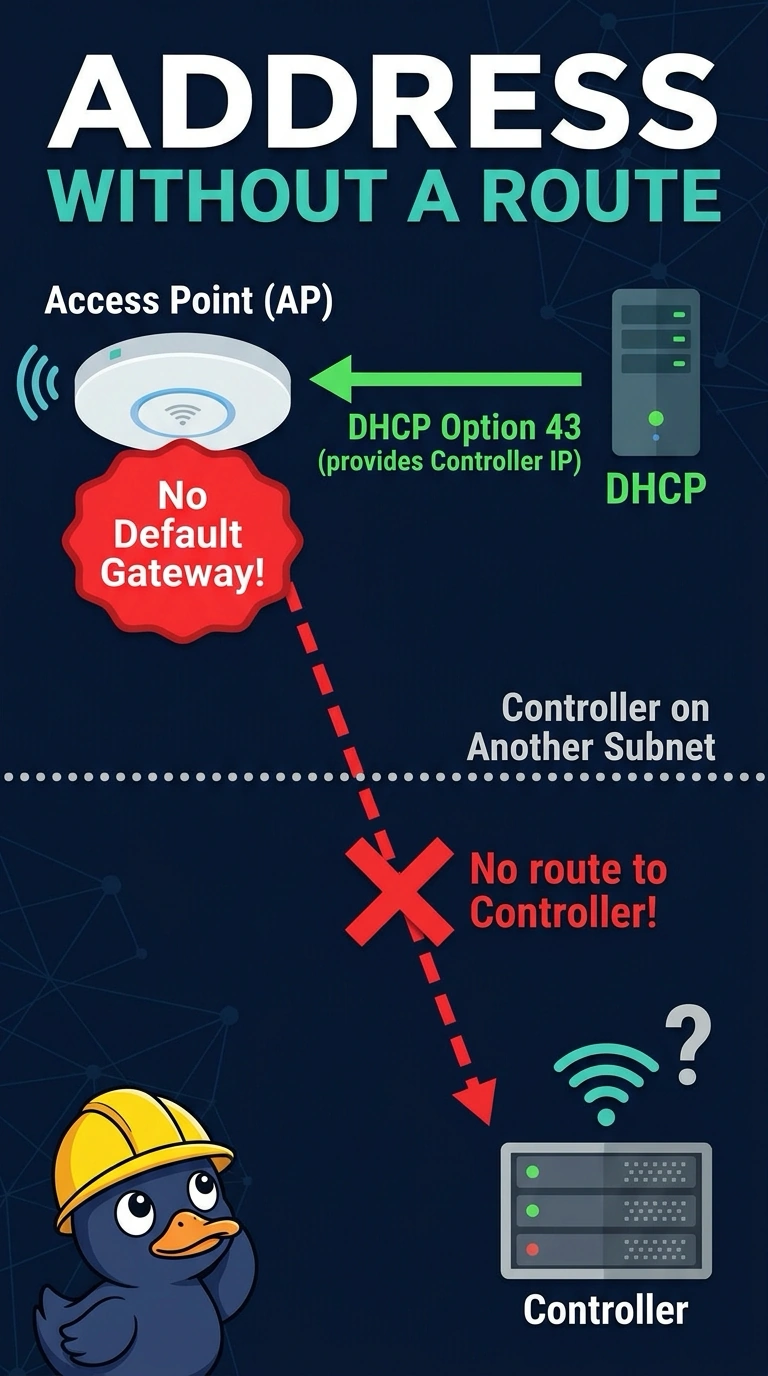
DHCP option 43 gives the correct controller address. The access point's own address is in a subnet with no default gateway, and the controller is on another subnet. The access point never joins. Why?
Select an answer to reveal the explanation.
Short Explanation
Your access point knows the controller address, but it still cannot leave its own subnet. With no gateway, there is no route to the controller. Option 43 did its job; your access point just cannot reach the address it supplied.
Full Explanation
Option 43 can supply the controller address and still leave your access point unable to join when the controller is on another subnet and the access point has no default gateway. The failure is the missing route: knowing the destination address does not give the access point a way to reach it. Option 43 does not block cross-subnet joins. A missing gateway does not make a broadcast cross every subnet; broadcasts stay in the VLAN. The controller is not rejecting the access point because it learned the address from option 43—the join request never arrives. For an exam, distinguish this from a case where a gateway exists but a firewall drops the control traffic: that failure occurs later. In practice, provide the access-point subnet with a gateway that can reach the controller, then confirm that the access point joins. Check one live client after the change, confirm the symptom on its next attempt, and leave the rest of the floor alone until that client matches the result you expected.