
At a stadium, a phone still shows a moderate received signal during the event, but throughput collapses as the noise floor rises. Which measurement explains that collapse better than the signal number alone?
Select an answer to reveal the explanation.
Short Explanation
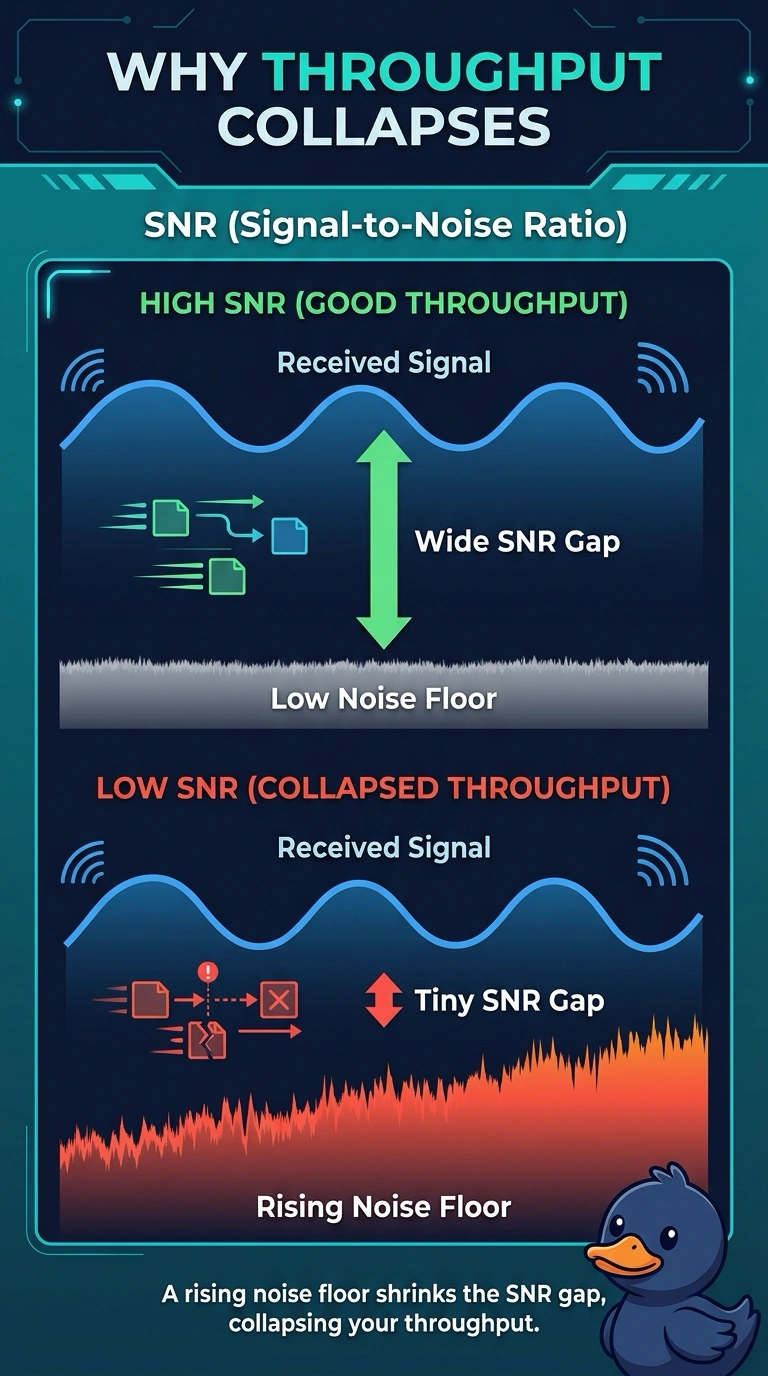
Two people can shout at the same volume and only one of them can be understood, once the crowd gets loud. Your phone's moderate signal did not change. The noise floor did, and the gap between them is the SNR that the data rate actually needs.
Full Explanation
SNR is the received signal minus the noise floor, expressed in dB, not a second copy of the signal strength. Modulation and coding need a minimum gap. When event noise rises and the signal stays moderate, SNR shrinks, the phone can no longer hold the high rate, and throughput collapses even though a quick look at RSSI still looks acceptable. The country code selects the legal channel table. It does not move during the event and it does not describe the relationship between signal and noise. EIRP of a rogue in a different band is a different transmitter's radiated power. Energy in another band is not the noise floor of the channel this phone is using, so it does not explain a same-channel collapse. DHCP lease length affects how often a phone renews an address. A phone that already has throughput, then loses rate as the noise floor rises, is an RF problem, not an address-timer problem. Exam caveat: a vendor RSSI scale is not SNR. Read the signal and the noise in the same unit, then subtract. Operational check: on the client detail, record signal and noise during the collapse and confirm the gap, not the signal alone, tracks the rate drop.