
A hospital runs a Catalyst 9800 high-availability pair in stateful switchover. The active controller fails. What should the access points do?
Select an answer to reveal the explanation.
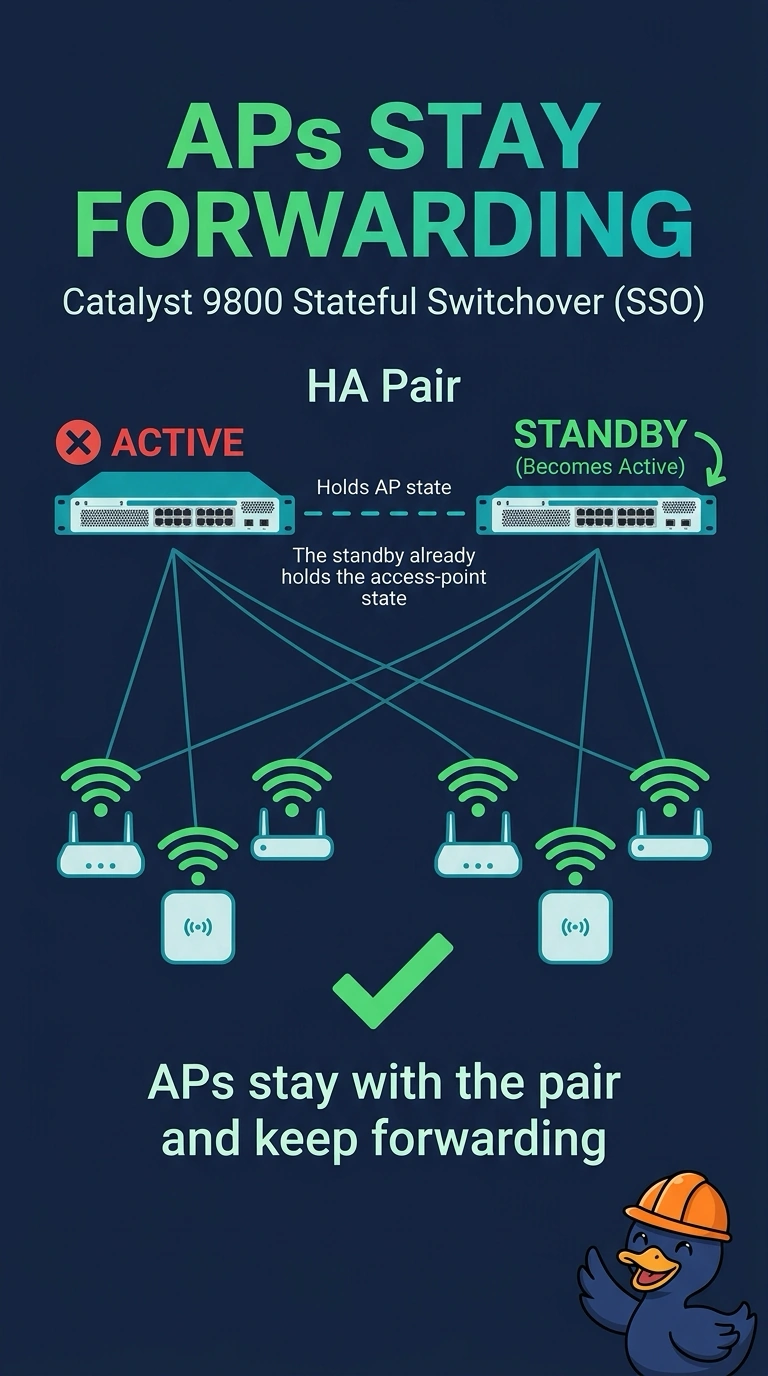
Short Explanation
Stateful switchover is a hot spare that already knows the patients, not a stranger the access points have to hunt for. Your access points should stay with the pair. Sending them back to discovery is the other kind of backup.
Full Explanation
In Catalyst 9800 stateful switchover the standby controller keeps synchronized access-point and client state. When the active unit fails, the standby takes over and the access points do not have to rediscover a controller or download a new configuration from scratch. That is the behavior this hospital designed. Dropping into discovery and waiting for DHCP option 43 is what happens when an access point has no remaining controller to talk to, which is closer to an N+1 backup that was never synchronized. SSO exists so that hunt does not happen. Sniffer mode is a capture mode an operator sets on an access point. A controller failover does not put radios into sniffer mode, and doing so would stop client service. The guest anchor VLAN is a tunneling design for guests. Failover of the pair is not limited to guests, and employee clients are part of the synchronized state too. Exam caveat: SSO needs the redundancy link and the matching software in place before the failure. A pair that never reached standby-hot will not fail over this cleanly. Operational check: confirm the pair shows the standby ready, then fail the active unit in a maintenance window and watch the access points stay joined instead of returning to discovery.