
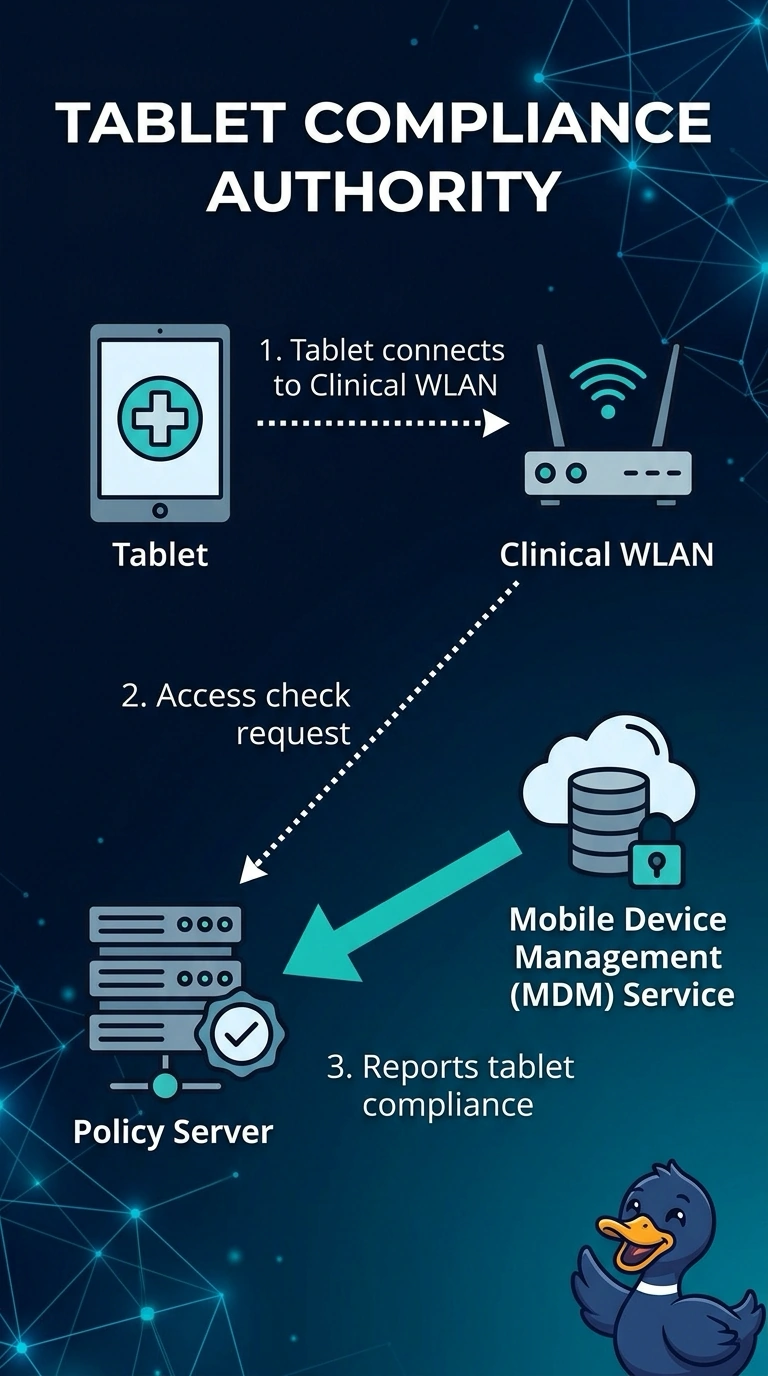
A hospital requires clinical tablets to pass a compliance check in the mobile device management service before the policy server will authorize them on the clinical WLAN. Which platform is the compliance authority in that design?
Select an answer to reveal the explanation.
Short Explanation
Compliance is a device-health verdict, not a strong signal. Your mobile device manager is the system that inspects the tablet and tells the policy server whether it passed. DHCP can hand out an address, and it still cannot declare the tablet healthy.
Full Explanation
Mobile device management holds the device posture: whether the tablet is enrolled, encrypted, and within policy. In this design the policy server, typically ISE, authorizes the WLAN session only after that service reports the tablet as compliant. The compliance authority is the device manager, and the policy server enforces the result. An RF tag groups radio profiles for access points. SNR is an RF measurement, not a compliance state, and no RF tag marks a tablet as healthy. Sniffer mode captures frames for an analyzer. It does not grant network access, and a capture is not a posture result. A DHCP server leases addresses. Lease length is a timer. A long lease does not mean the tablet is enrolled or encrypted, and DHCP is the wrong place to make the allow-or-deny decision the hospital described. Exam caveat: the policy server still has to be integrated with the device manager, and the authorization rule has to require the compliant result. A tablet that is compliant in the device manager and unknown to the policy server is not on the WLAN yet. Operational check: fail one test tablet in the device manager, confirm the policy server sees non-compliant, and confirm that tablet is denied or quarantined while a compliant tablet is allowed.