
A manufacturer's new access points join an old lab controller instead of the new campus controller. DHCP has no controller option, and the name CISCO-CAPWAP-CONTROLLER still resolves to the lab address. What should change?
Select an answer to reveal the explanation.
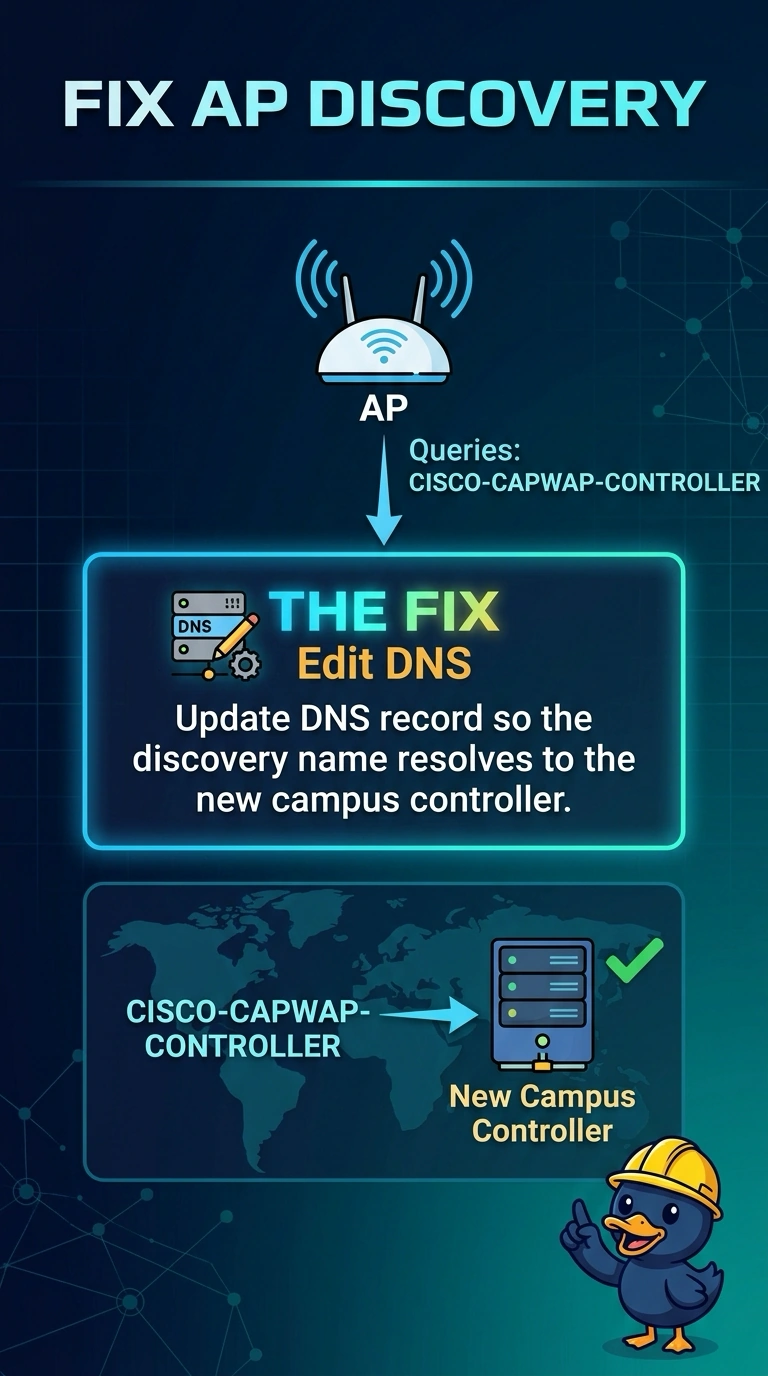
Short Explanation
The access points are following an old street sign. That well-known DNS name still points at the lab, so your new units join the lab. Changing the guest VLAN does not repaint the sign.
Full Explanation
When DHCP does not supply a controller address, Cisco access points can discover one by resolving CISCO-CAPWAP-CONTROLLER in the domain they receive. This site still resolves that name to the lab controller, so new access points join the lab even though a campus controller exists. Updating the DNS record to the campus controller address sends discovery to the right place. The guest VLAN is a client network after an access point has joined and is serving a WLAN. It is not consulted to choose a controller during CAPWAP discovery. The mandatory data rate is a radio parameter for clients. An access point does not use it as a controller address. Antenna mode shapes the RF pattern. It does not encode a discovery target, and the nearest access point is not how this DNS method selects a controller. Exam caveat: access points that have already joined the lab may keep that controller until they are primed or the old entry is cleared. Fixing DNS helps the next discovery. It does not always move an access point that is happily joined. Operational check: query the discovery name from the access-point VLAN, confirm it returns the campus controller, and watch a factory-reset access point join that address.