
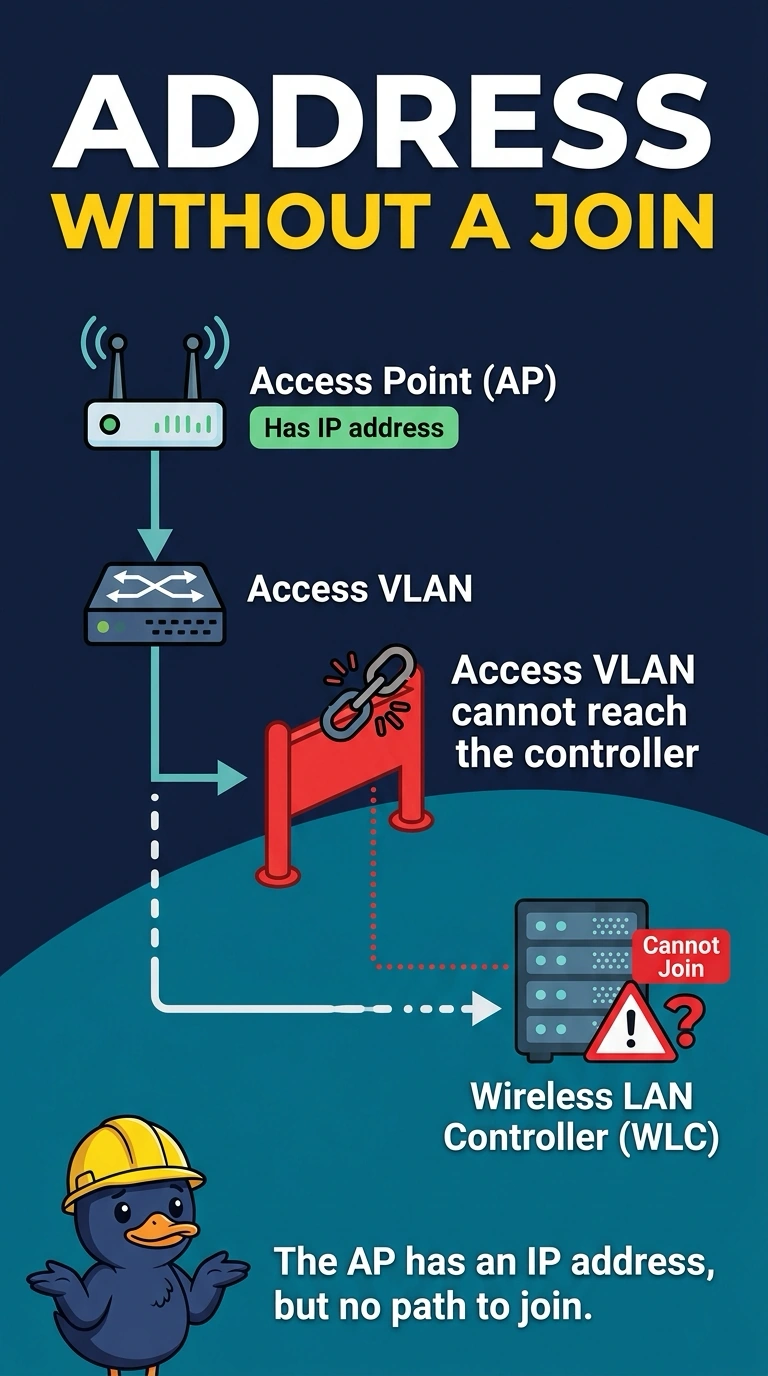
A local-mode access point on an access port receives an address and never joins. That VLAN has no path to the controller. Other access points on a VLAN that can reach the controller join. What is wrong with this port?
Select an answer to reveal the explanation.
Short Explanation
The access point got an address on a VLAN that does not go anywhere near the controller. Local mode only needs that port to be the path the access point itself uses to join. Put your port in a VLAN that can reach the controller.
Full Explanation
A local-mode access point joins from the access VLAN on its port, and client VLANs live at the controller. This port's VLAN has no path to the controller, so the access point has an address and never joins, while access points on a reachable VLAN do. The port does not need to trunk every client VLAN for the join. The client VLAN does not have to be the access VLAN. Sniffer mode is not required to start a join. A local-mode access point on an access port got an address in a VLAN that cannot reach the controller. The access VLAN is the management path. Check one live client after the change and leave the rest of the floor alone until that client matches the result you expected. Confirm the symptom on the next attempt before changing anything else. Exam caveat: a VLAN that can route to the controller and a firewall that drops the control ports still fail. After the VLAN is right, confirm the path allows the join. Operational check: move the port to the VLAN the working access points use and confirm this one joins.