
A bank brings up a new Catalyst 9800, and the access points join, but every radio stays disabled. The controller has no country configured for the branch where those access points are installed. Which initial-setup item lets the radios operate in that country?
Select an answer to reveal the explanation.
Short Explanation
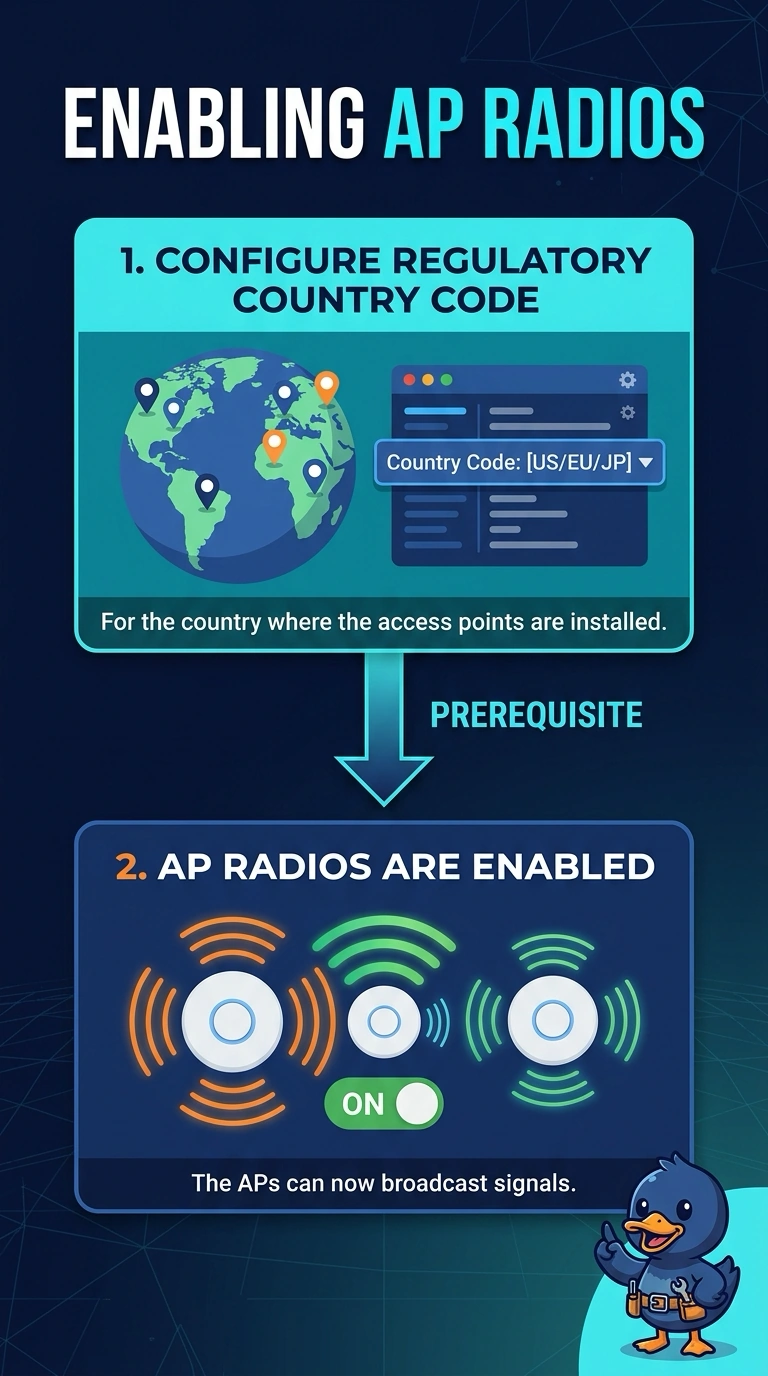
You need to configure the regulatory country code for the branch so the radios can use a legal channel plan. A guest mobility anchor forwards visitor traffic, while an RF tag cannot skip the country check by setting maximum power. Sniffer mode captures traffic; it does not exempt access points from regulation.
Full Explanation
A Catalyst 9800 will not let access-point radios transmit until a country code is configured, because channel and power limits are legal rules, not local preferences. Access points can complete CAPWAP join and still keep radios disabled when the country where they are installed has never been set. Configuring the branch’s actual regulatory country code is the initial-setup item that allows the radios to come up on a legal channel plan. A guest mobility anchor is a traffic-forwarding design for visitor sessions; it has nothing to do with whether a radio can leave the disabled state. An RF tag can shape channel and power later, but setting maximum power does not bypass the country requirement, and ignoring regional limits is not a legal setup. Sniffer mode is a capture mode, not an exemption from the regulatory domain; lobby access points in that mode would stop serving the branch. Exam caveat: some newer access points can learn regulatory domain from location or a regulatory activation file, but when the controller shows no country and every radio is held down, configure the country rather than changing a WLAN. Operational check: after setting the country, confirm the radios become enabled on channels allowed by that country’s plan.