
A university is building SD-Access and wants user traffic from the wireless clients encapsulated to the fabric edge, not carried in a controller data tunnel, while the access points remain controlled by the wireless controller. Which architecture is that?
Select an answer to reveal the explanation.
Short Explanation
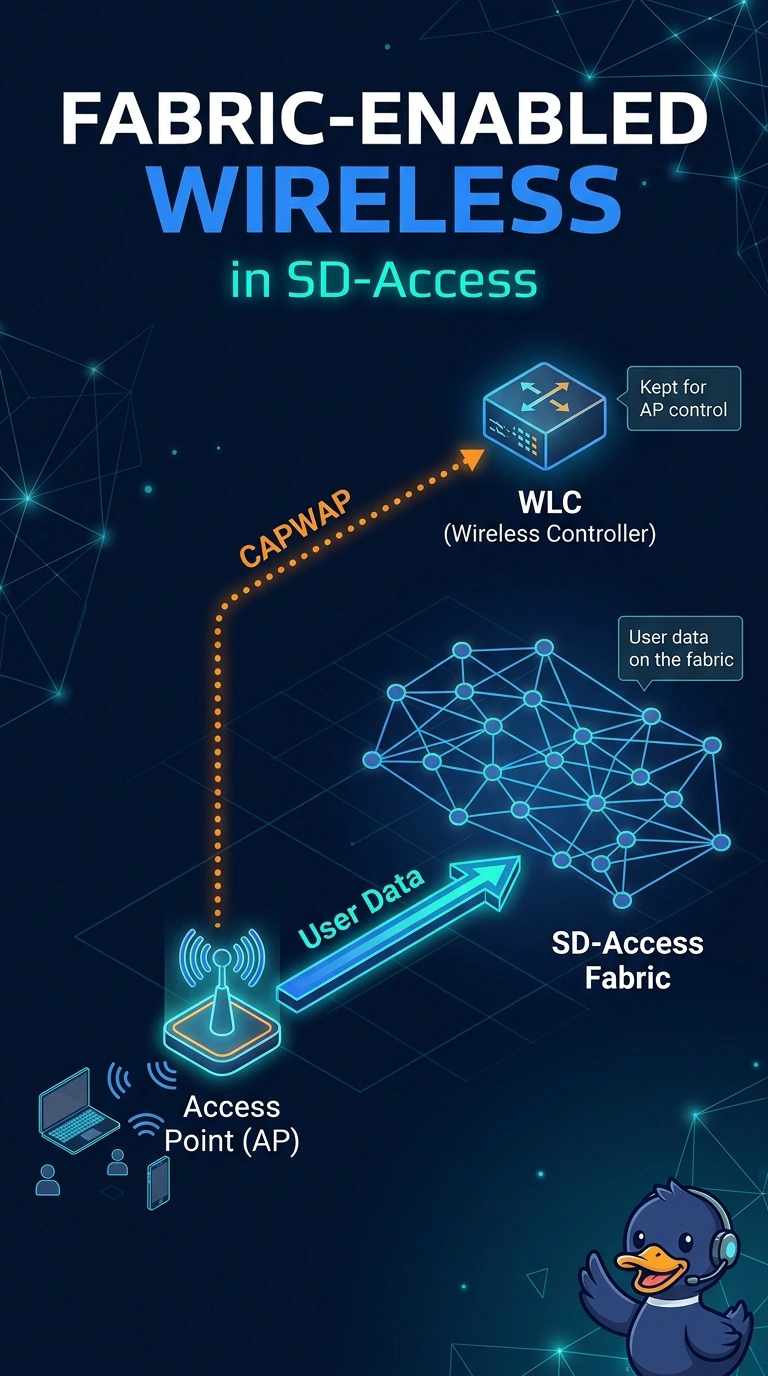
You’re looking for fabric-enabled wireless: the controller still controls the access points, while client traffic goes to the fabric edge instead of through a controller data tunnel. Local mode sends client data to the controller, so it does not meet your requirement.
Full Explanation
With fabric-enabled wireless, the access point keeps a CAPWAP control relationship with the wireless controller, while client data is encapsulated to the fabric edge rather than tunneled to the controller as CAPWAP data. The controller and fabric provide policy, but client traffic does not hairpin through the controller. This meets your requirement to keep controller-based access-point control while carrying user traffic on the fabric. Local-mode wireless uses CAPWAP to tunnel client data to the controller; the access-point switch port is normally a single access VLAN for the access point, not a bridge for every client VLAN. Mesh mode uses a wireless backhaul to a wired root access point; bridging clients onto a local access VLAN does not deliver client traffic through the fabric overlay. Cloud-only dashboard management may manage a different wireless architecture, but it does not replace the wireless controller in this SD-Access design, which still needs the controller for access-point control. Exam caveat: an access point can sit over the fabric while retaining classic CAPWAP data tunneling, so a fabric connection alone does not prove the data plane is fabric-enabled. Practical check: confirm that the access points are fabric-enabled and that a client session is switched at the fabric edge, not centrally switched as CAPWAP data.