
At a plant, new access points join the wireless controller, but on several of them one radio never comes up. The switch reports that those ports are supplying a lower PoE class than the access points requested. What should be checked first?
Select an answer to reveal the explanation.
Short Explanation
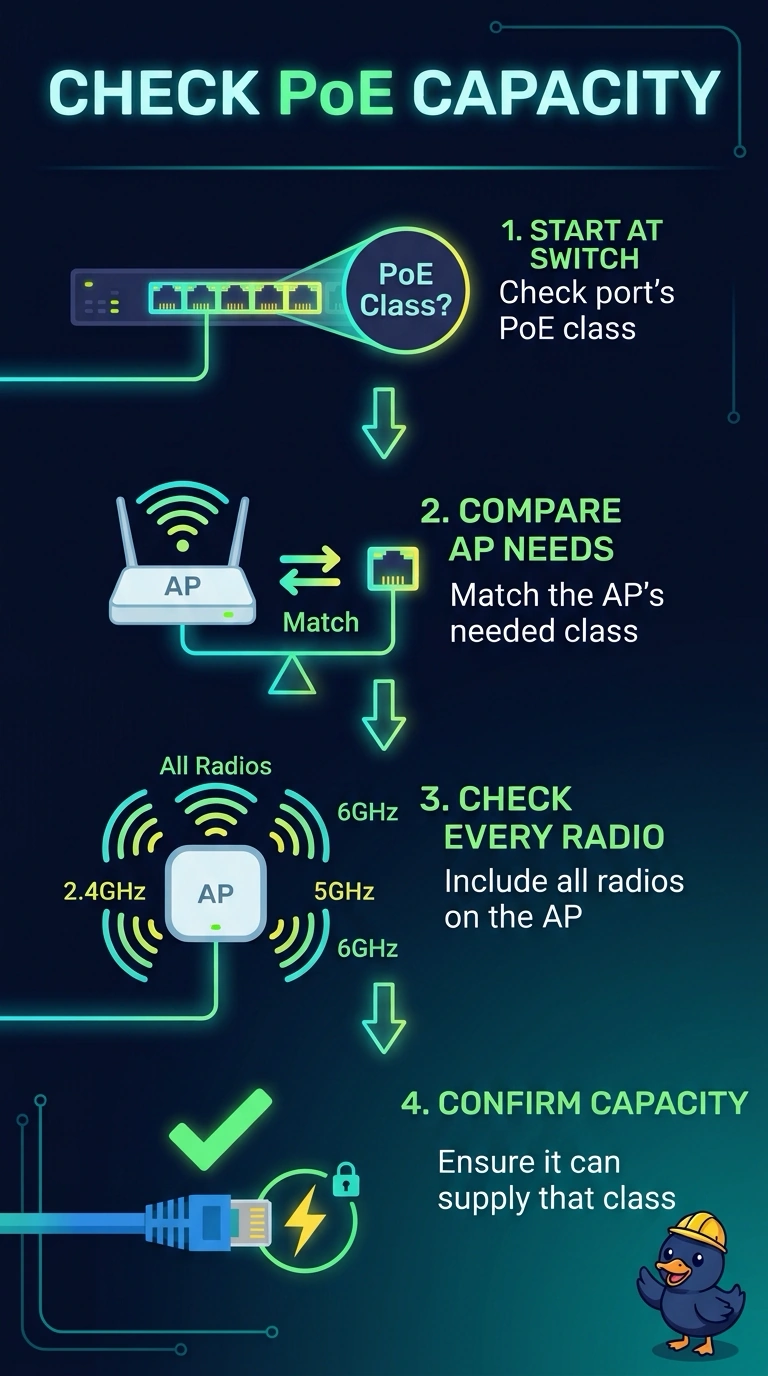
The access point got on the controller with a half-fed power supply, and a radio that is not powered does not come up because of an ACL. Your first look is the PoE class the switch is actually granting. A hidden name on the WLAN does not hold the radio in reset.
Full Explanation
Modern access points budget radios, USB, and extra chains against the PoE class the switch delivers. When the port grants a lower class than the access point requested, the access point can join the controller on the remaining power and still leave a radio down or reduced. The switch log already says the granted class is low, so the first check is whether that port, the power supply, and the cable can deliver the class the access point needs. A mesh backhaul matters for an access point whose uplink is wireless. These access points joined through the wire, so a missing mesh link is not why a radio stayed down after a successful join. A management ACL that blocked client DHCP would leave clients without addresses after they associated. It would not stop a radio from starting, and the symptom is a radio that never comes up. Hiding an SSID only omits the name from beacons. The radio still starts, and clients can probe for the hidden name. It is unrelated to PoE. Exam caveat: do not guess a wattage from the access-point marketing name. Read the class the access point requests and the class the switch grants for that exact model. Operational check: on the switch port, compare requested and granted PoE, then confirm the radio state on the controller after the port supplies the requested class.