
A logistics aisle has no Ethernet run, and the new access point there must carry clients and reach the controller through a nearby access point that does have a cable. Which architecture fits that aisle?
Select an answer to reveal the explanation.
Short Explanation
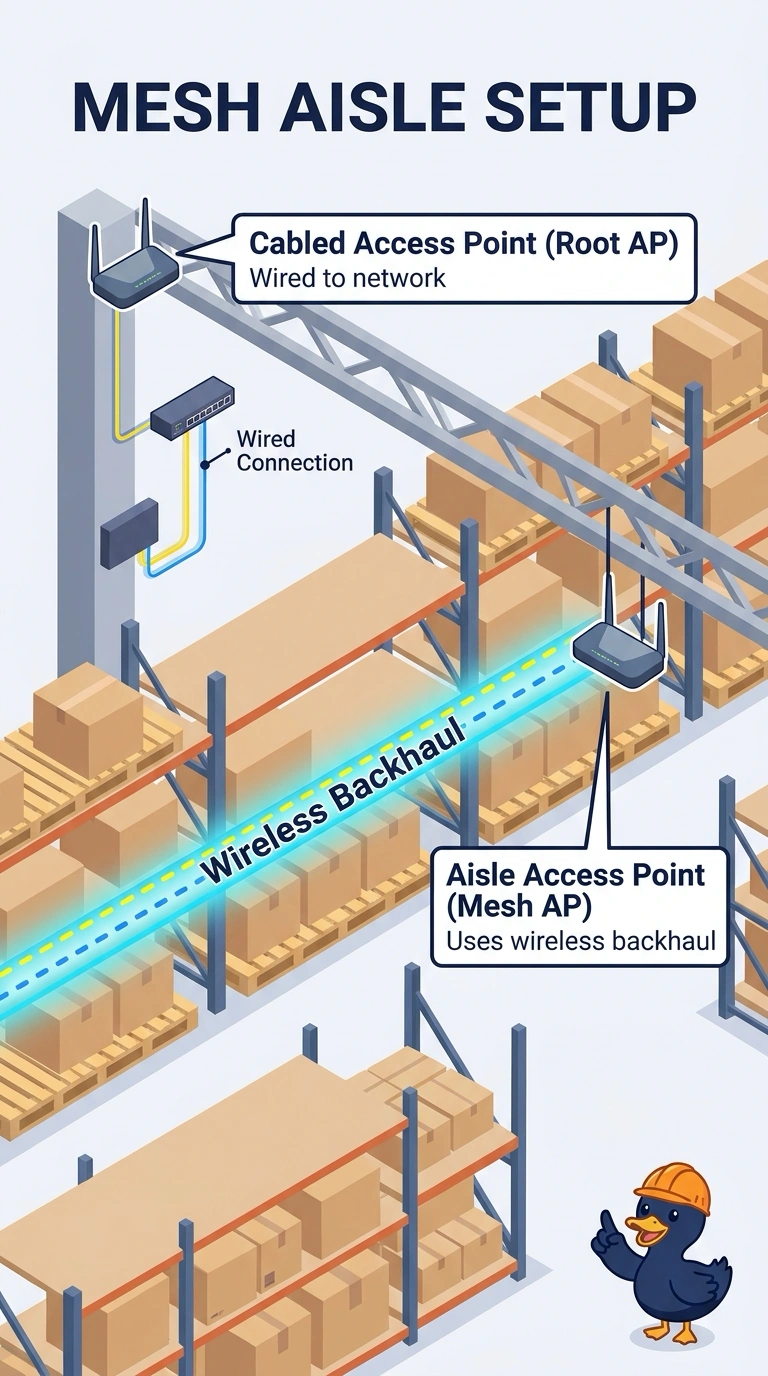
Mesh is a wireless extension cord. The cabled access point is the root plugged into the wall, and the aisle access point hangs off that radio backhaul. You cannot put the aisle unit in local mode and pretend the cable is optional.
Full Explanation
A Cisco mesh uses a root access point on the wired network and mesh access points whose backhaul is wireless. The aisle unit has no cable, and the nearby cabled unit can be the root, so mesh is the architecture that both serves aisle clients and gives the aisle access point a path to the controller. Local mode expects a wired CAPWAP path. An aisle access point set for local mode does not join through a neighbor's radio, and it will not come up just because a root is nearby. Monitor mode scans channels and does not serve clients or lend its IP address to another access point. A guest anchor tunnels guest sessions between controllers. It is not a substitute for an access-point uplink, and it does not connect an unwired access point to the network. Exam caveat: the root needs a clear radio path and enough backhaul capacity, because every aisle client shares that wireless hop back to the cable. Operational check: confirm the cabled unit is the root, the aisle unit joins as a mesh access point, and a test client on the aisle gets an address through that backhaul.