
A hotel wants lobby visitors to join a WLAN with no password and no 802.1X login, while still encrypting each visitor's frames so other guests cannot sniff them. Which security configuration matches that requirement?
Select an answer to reveal the explanation.
Short Explanation
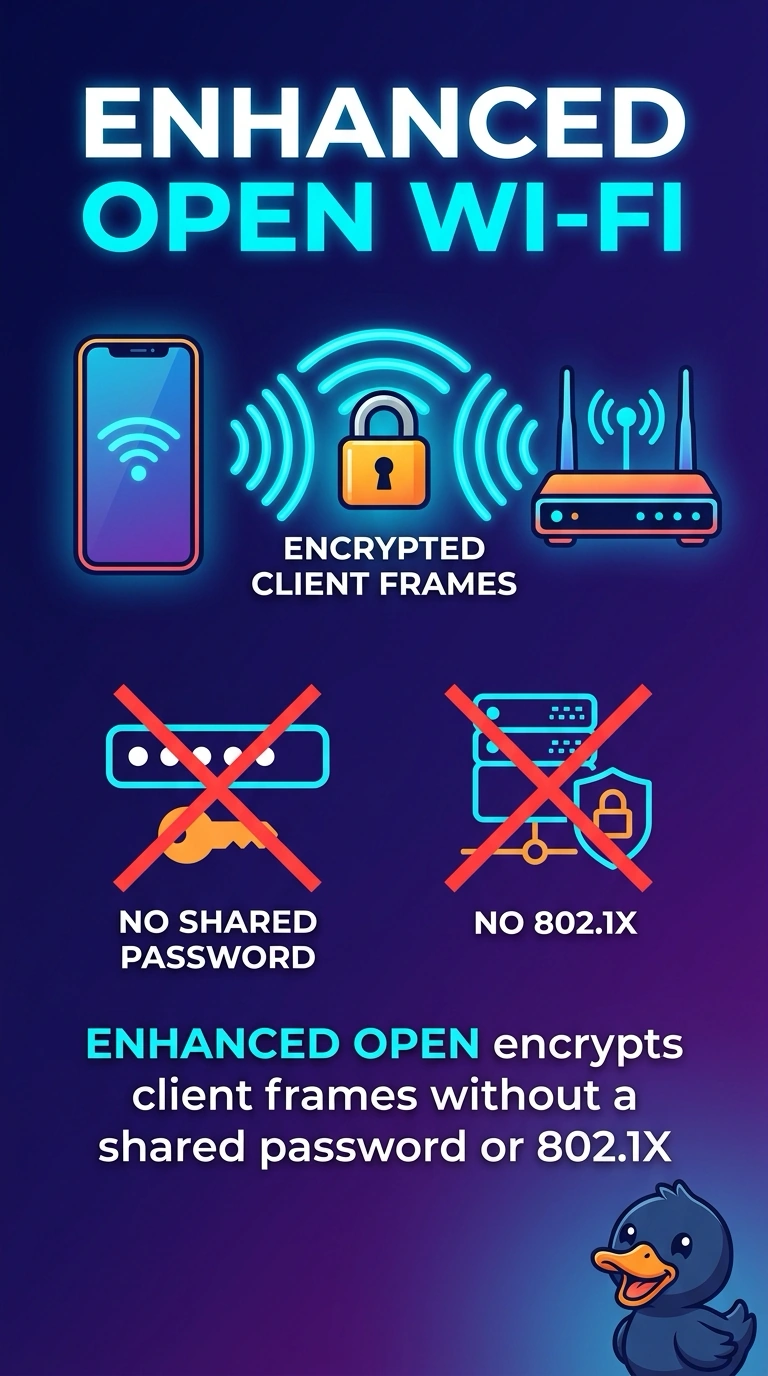
An open network is a postcard, and a shared password is a key you hand to the whole lobby. Enhanced Open gives each visitor a private envelope without asking for that key or for a corporate login. If your design still has a password, you built a different WLAN.
Full Explanation
Enhanced Open uses opportunistic wireless encryption so each associated client gets pairwise encryption without a pre-shared key and without an 802.1X authentication server. That is the combination the hotel described: anyone may join, and another guest on the same SSID still cannot read the frames. Open authentication with encryption disabled lets visitors join, but the frames are readable to anyone in radio range, so it fails the sniffing requirement. WPA3-Enterprise is 802.1X. It needs a supplicant and a RADIUS policy, which is the login the hotel said it does not want, even though the encryption itself is strong. WPA3-Personal uses SAE and a password. The encryption is real, but every guest has to be given that password, and anyone who has it is inside the same passphrase group. The requirement said no password. Exam caveat: Enhanced Open protects the link, it does not identify the visitor. If the hotel later needs a sponsor or an accept-terms page, that is a guest portal on top, not a reason to drop the encryption. Operational check: confirm the WLAN security shows Enhanced Open, associate a test phone, and verify the client session is encrypted rather than open.