
University voice handsets complete a full EAP exchange every time they change access points, and the call audio gaps. The WLAN is already 802.1X. Which roaming mechanism avoids repeating that full EAP exchange inside the same mobility domain?
Select an answer to reveal the explanation.
Short Explanation
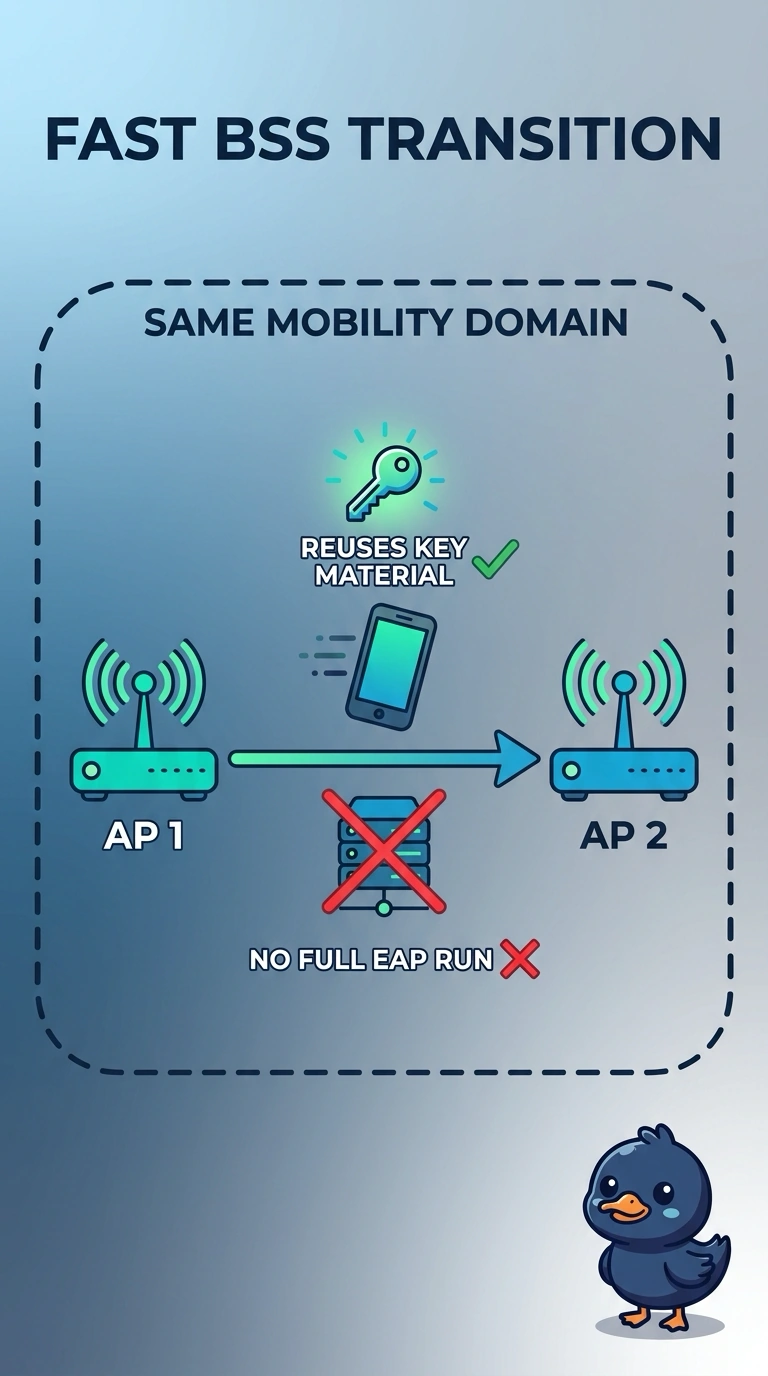
A full EAP login at every doorway is like badging into each room of a building you already entered. Fast BSS transition lets your handset reuse key material from the initial authentication as it moves within the mobility domain. Hiding the SSID does not shorten that badge-in.
Full Explanation
Fast BSS transition, or 802.11r, lets a client roam within a mobility domain using key material derived from the initial EAP authentication instead of running EAP against the RADIUS server at every access point. Because the handsets already use 802.1X, the full exchange is what causes the audio gap; enabling fast transition, with compatible handsets, avoids repeating it. Hiding the SSID does not disable roaming or cache keys: handsets still need to find the next access point, usually with probes, and would still reauthenticate. Putting each roam on a new VLAN creates a Layer 3 roam; the client needs a new forwarding path and often a new address, which can lengthen the gap, and the VLAN change does not preserve the security association in place of EAP. Protected management frames protect management traffic and are expected with WPA3, but disabling them does not remove the EAP method or shorten a roam that still performs full 802.1X. Exam caveat: the client decides when to roam, so fast transition shortens a roam the handset already attempts; a sticky handset that stays on a weak access point may still need a better roam trigger. Practical check: roam a test handset and confirm the RADIUS log shows the initial EAP success without a new full EAP success at the second access point.