
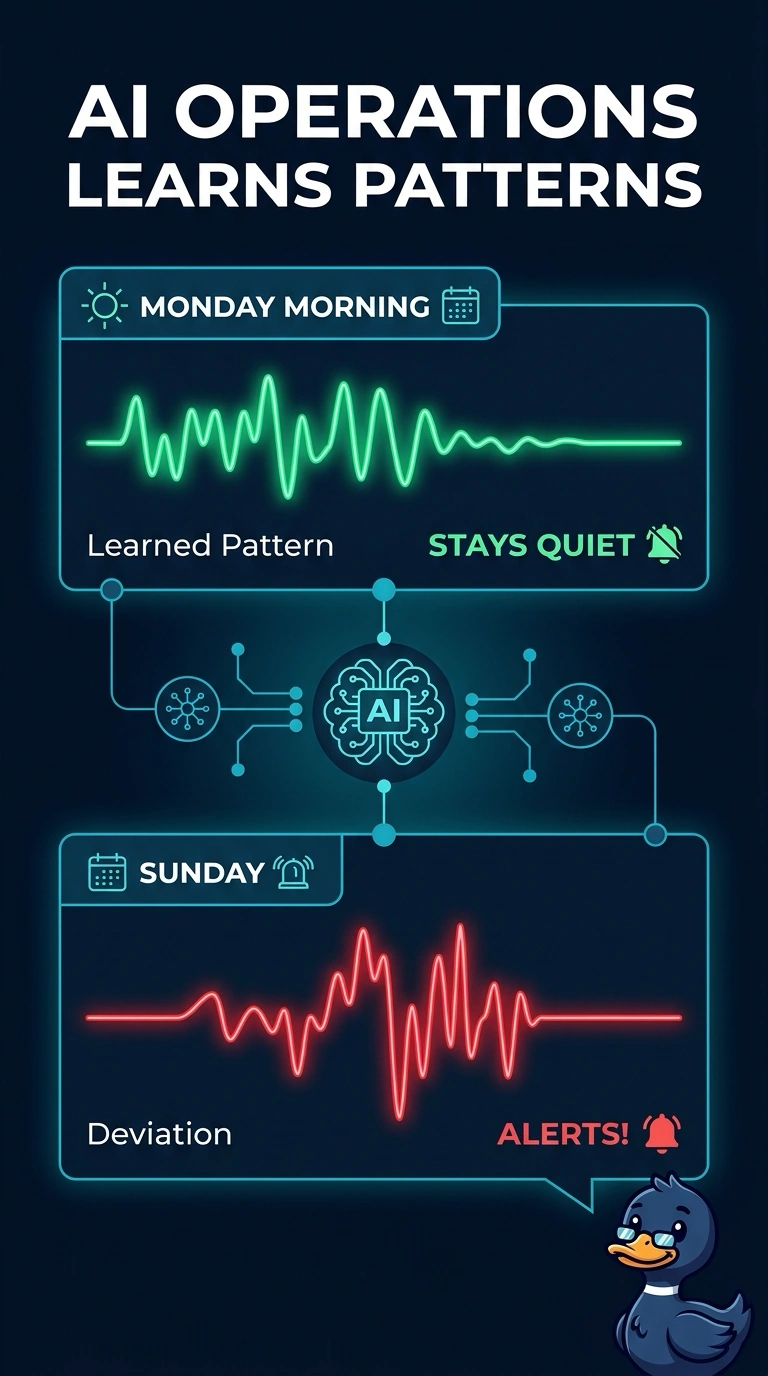
Every Monday morning a campus wireless utilization peak is normal, and a Sunday peak of the same size is not. The team wants Catalyst Center to page only for the Sunday case. Which capability does that?
Select an answer to reveal the explanation.
Short Explanation
A static alarm cannot tell a normal Monday rush from a Sunday surprise. AI Operations learns the Monday shape and pages you when Sunday does not fit that shape. Parking the traffic in a guest VLAN does not teach it the calendar.
Full Explanation
AI Operations in Catalyst Center learns a baseline for measurements such as utilization, including patterns that repeat, and it raises an anomaly when live data departs from that baseline. A Monday morning peak that happens every week becomes part of the learned pattern and should not page. The same size peak on Sunday is a deviation, and that is the alert the team wants. A static threshold has no calendar. If it is set under the Monday peak it pages every Monday, and if it is set above that peak it also misses Sunday. It cannot select only the unusual day. An RF tag binds radio profiles to access points. It does not classify clients as healthy because a channel is busy, and it does not decide which days page the operator. A guest anchor tunnels guest sessions. It does not absorb a utilization peak into a DMZ VLAN, and it is not a baseline engine. Exam caveat: a baseline is only as good as the history it learned. A brand-new site will not yet know that Monday is normal, so early alerts need a human look. Operational check: compare the Monday and Sunday events in the AI Operations view and confirm only the Sunday deviation is raised after the baseline includes several normal Mondays.