
A SaaS campus wants channel and power decisions based on long-term RF telemetry analyzed in the cloud and applied through Catalyst Center, instead of only the controller's recent local measurements. Which capability is that?
Select an answer to reveal the explanation.
Short Explanation
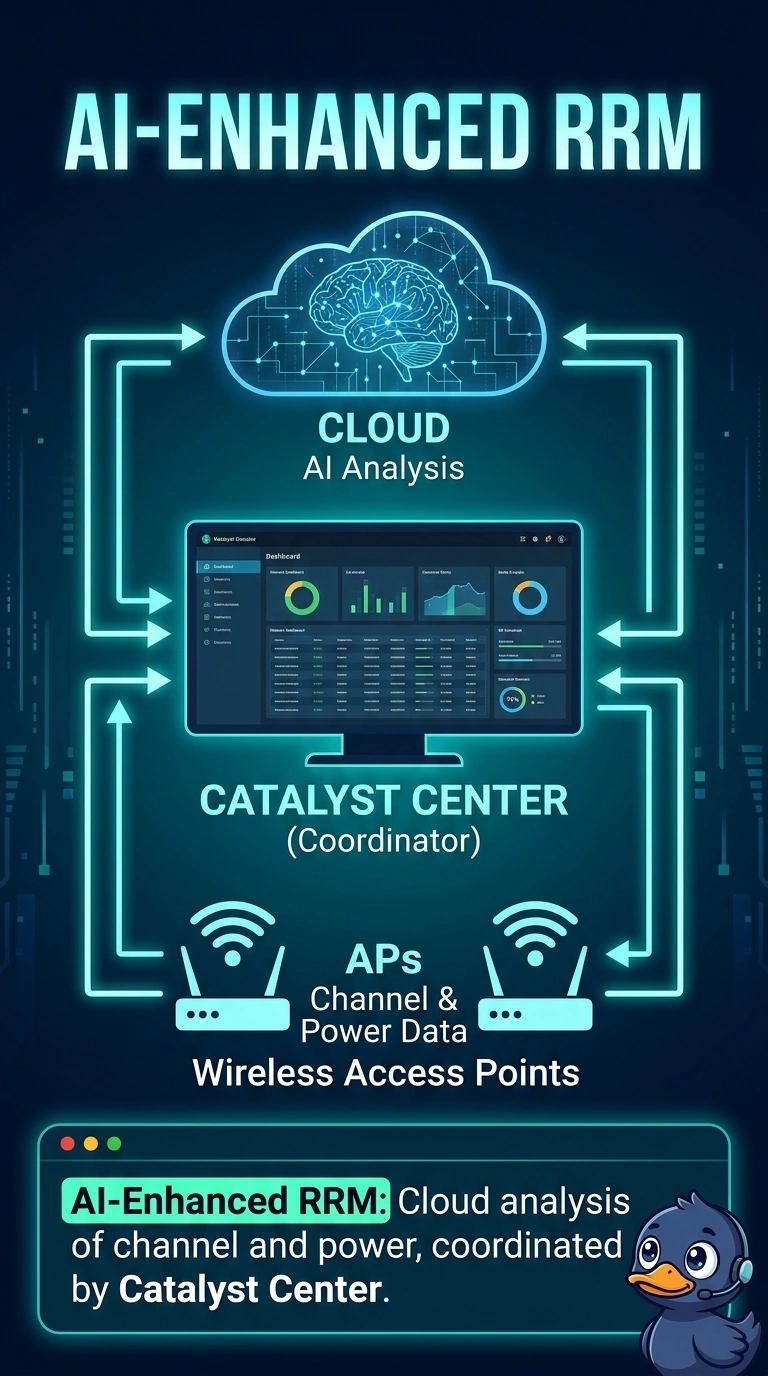
Your local RRM is a short look out the window. AI-Enhanced RRM keeps the longer weather record in the cloud and still hands the channel and power changes back through Catalyst Center. A guest anchor does not forecast the RF.
Full Explanation
AI-Enhanced RRM collects RF telemetry through Catalyst Center, analyzes it in the Cisco AI cloud, and returns channel and power changes, including the cloud-side DCA and TPC work, for the controller to apply. That is the capability that uses long-term cloud telemetry instead of only the recent measurements the controller's own RRM holds locally. A guest anchor tunnels guest sessions to a DMZ controller. It does not retune channels, and the DMZ VLAN is not an RF input. A static channel on one access point freezes that radio. It is not a cloud model of the campus, and it ignores the rest of the telemetry the team wants used. Sniffer mode captures frames on one channel. It does not replace transmit-power control, and the RRM leader is not an access point you put into sniffer mode to run the campus. Exam caveat: AI-Enhanced RRM does not take every RF job off the controller. Coverage-hole reactions and other latency-sensitive pieces still run locally, while the cloud handles the heavier channel, power, bandwidth, and flexible-radio decisions. Operational check: confirm the site is enrolled for AI-Enhanced RRM in Catalyst Center and that a recommended channel or power change lands on the controller before you set radios to static.