
A university sets every access point in a dense lecture hall to 160 MHz channels. Retries rise and per-client throughput falls, even though each channel is wider. Why?
Select an answer to reveal the explanation.
Short Explanation
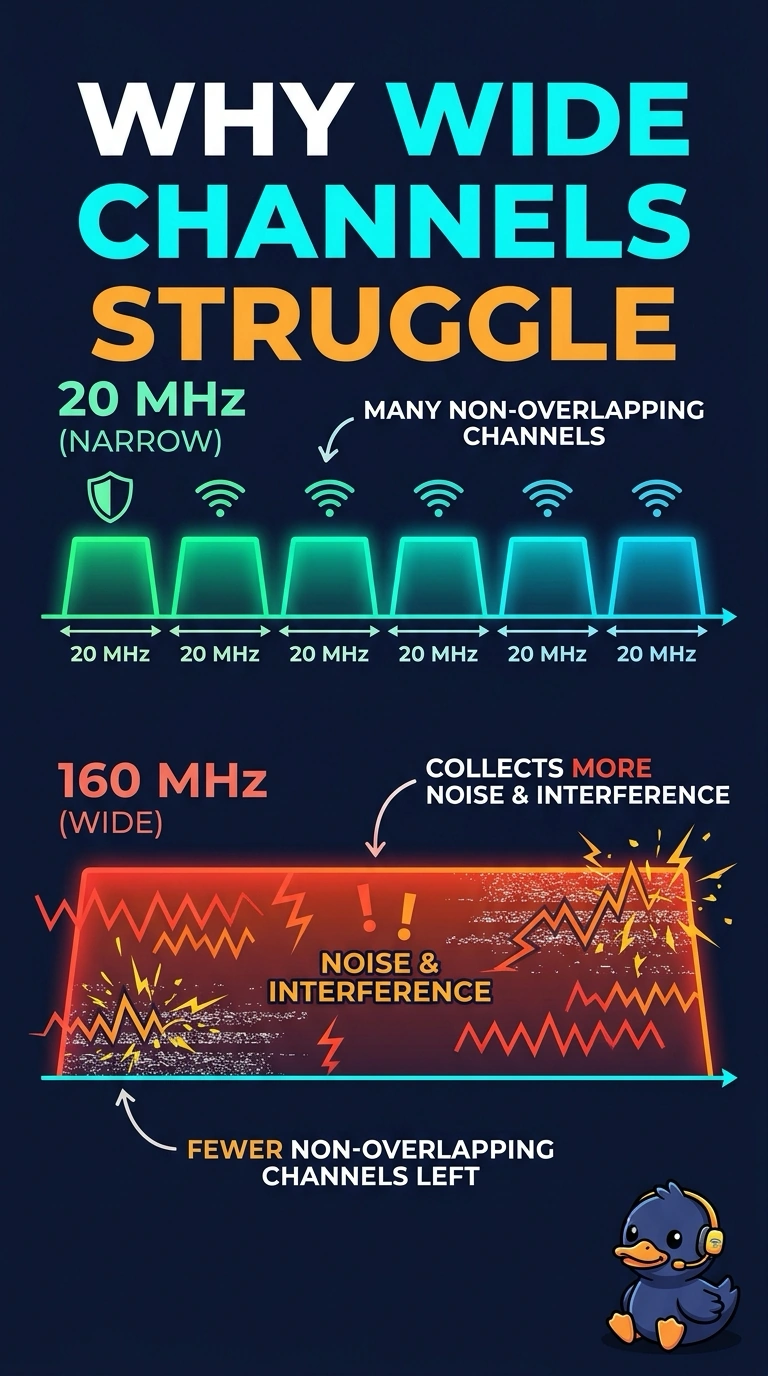
A wider channel is a bigger net. In a crowded hall it also scoops up more noise, and you have fewer of those nets to reuse. Your retries went up because the channel got greedier, not because the name of the network disappeared.
Full Explanation
Wider channels carry more data when the channel is clean and you have enough of them. In a dense hall, 160 MHz also accumulates noise and interference across a much larger slice of spectrum, and it leaves very few non-overlapping channels so neighboring access points land on top of each other. Retries rise and each client spends airtime on failures, so per-client throughput falls even though the channel number sounds faster. OFDMA is a Wi-Fi 6 scheduling method. A 160 MHz channel does not disable it, and it does not limit the BSS to one associated client. DHCP lease length is an address timer. Channel width does not shorten it, and clients are not failing because they renew too often. The symptom is retries and throughput. A wide channel does not hide the SSID. Beacons are still sent, and clients that are associating and then retrying have already found the BSS. Exam caveat: 160 MHz can be a good choice in a quiet, low-density space with a clean band. The hall is the opposite of that. Width is a design trade, not a setting you max out everywhere. Operational check: compare channel utilization and retry rates at 160 MHz and at a narrower width in the same hall before you keep the wide plan.