
A campus deploys many access points under one SSID so laptops can roam between them. There is no laptop-to-laptop ad hoc network. Which topology is this?
Select an answer to reveal the explanation.
Short Explanation
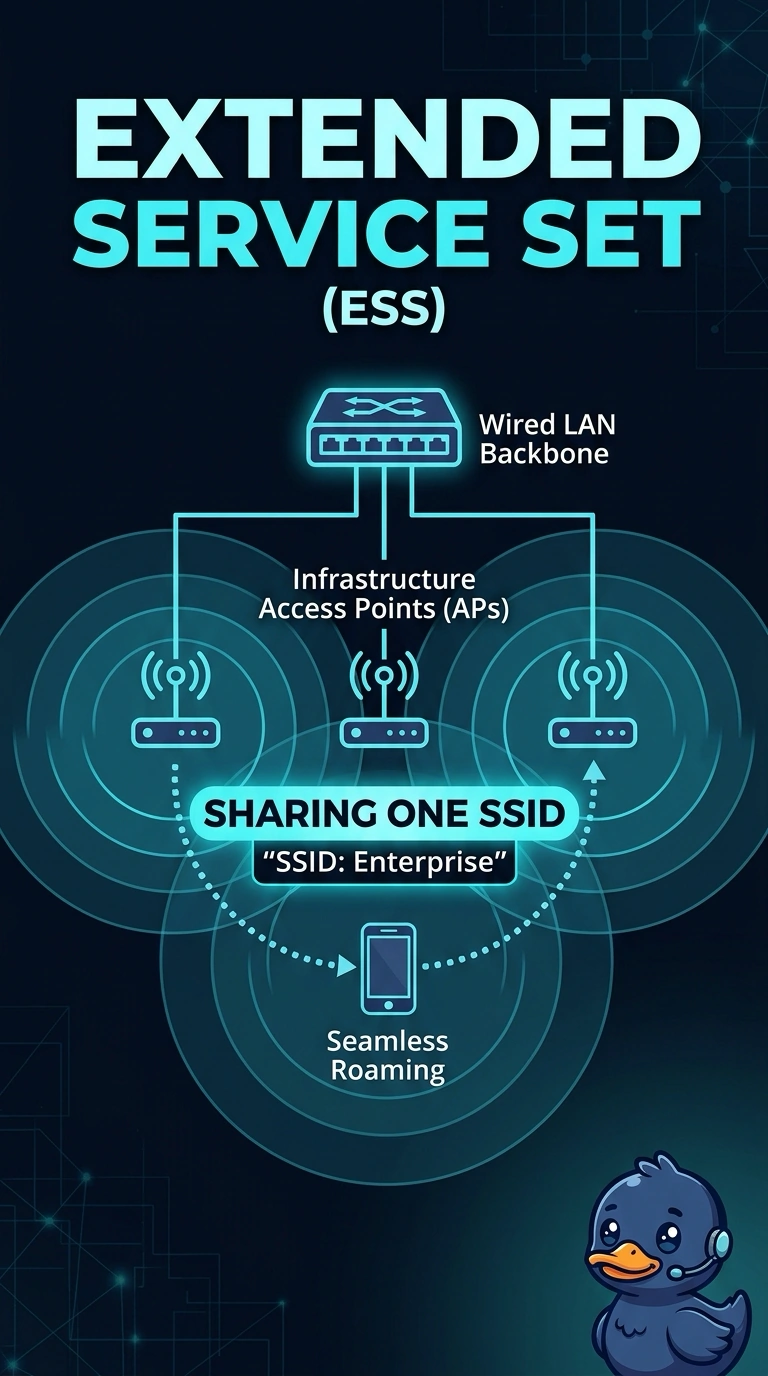
One access point is a basic service set. A campus full of them under one name, with laptops roaming, is an extended service set. Your users are not peering ad hoc, and they are not a bridge.
Full Explanation
A basic service set is one access point and its clients. An extended service set is a set of infrastructure access points sharing an SSID so clients can roam. The campus described many access points, one SSID, and roaming, with no ad hoc laptop network. That is an extended service set. An independent basic service set is ad hoc: stations peer without an access point. The campus explicitly is not that. One SSID does not mean one access point. The SSID is the name of the extended set, and each access point is its own basic service set inside it. A point-to-point bridge links two wired networks over a radio hop. Roaming laptops are clients of infrastructure access points, not the two ends of a bridge. Exam caveat: the roam only works if the security and the SSID really match. Two access points with the same name and different security are not one extended set to the client. Operational check: confirm neighboring access points advertise the same SSID and security, and that a laptop roams from one to the next without a new manual join.