
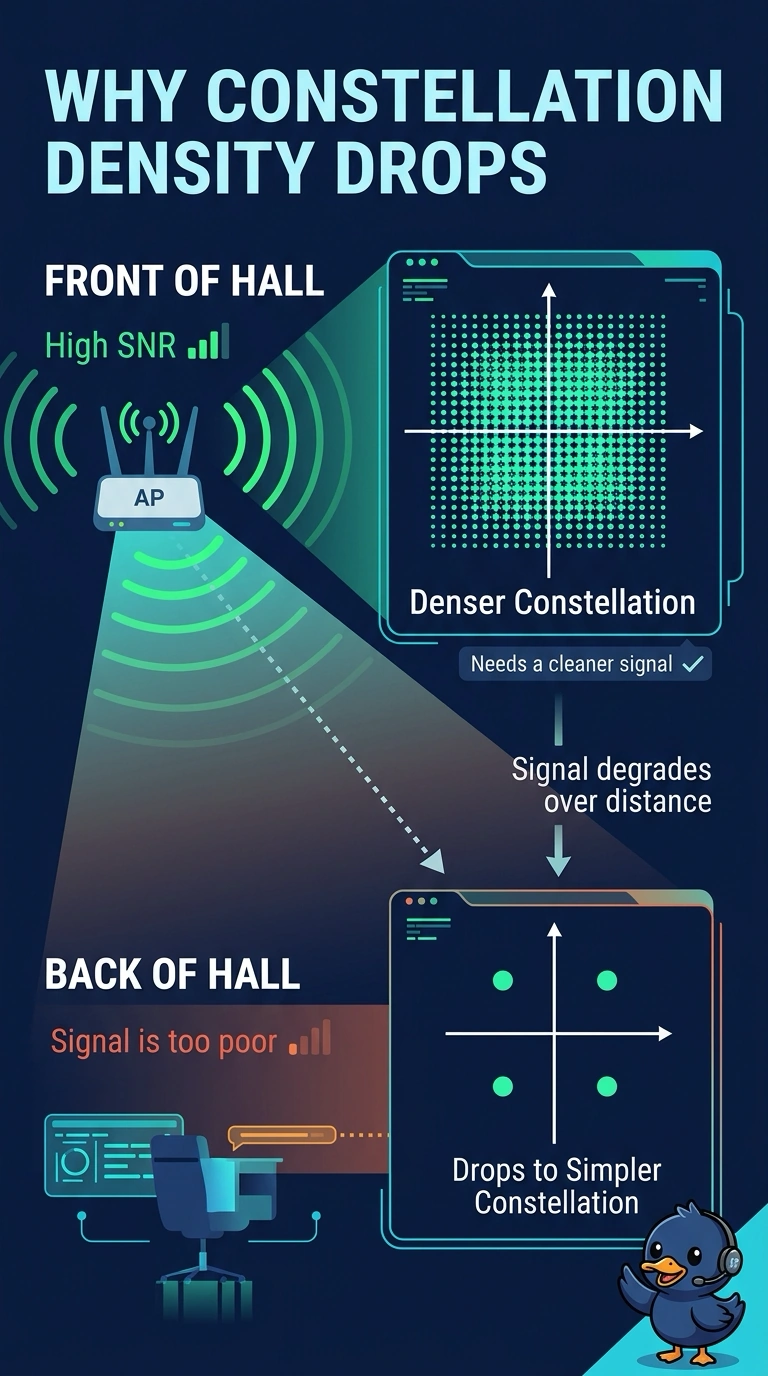
Laptops next to a lecture-hall access point use a denser constellation, and laptops at the back of the hall fall to a simpler one. SNR is high in front and poor at the back. Why does the back of the hall drop?
Select an answer to reveal the explanation.
Short Explanation
A denser constellation is a finer alphabet, and it needs a quiet room. The back of your hall is not quiet enough, so the laptops fall back to a simpler one. Nobody changed the country on the way to the door.
Full Explanation
Higher-order modulation packs more bits into a symbol and needs a higher SNR to be demodulated. Laptops next to the access point have that SNR and hold the denser constellation. Laptops at the back do not, so the rate falls to a simpler constellation they can still decode. The drop is the signal quality, not a refusal to associate. The denser rate is not mandatory at the back. If it were mandatory everywhere, the back laptops would fail to associate rather than step down. The country code does not change with SNR. DHCP does not offer a constellation, and the lease and the beacon are not a modulation selector. The PHY picks the rate from the conditions. Denser modulation needs a higher signal-to-noise ratio. The back of the hall still associates and simply cannot hold that denser rate. Exam caveat: a mandatory rate set can remove the simpler rates and then the back of the hall will not step down. It will drop. Know whether the simpler rate is still allowed. Operational check: read the MCS or constellation for a front-row laptop and a back-row laptop and compare their SNR.