
A university design requires a laptop to use two bands at the same time to one access point, as a single multi-link device. Which generation adds that operation?
Select an answer to reveal the explanation.
Short Explanation
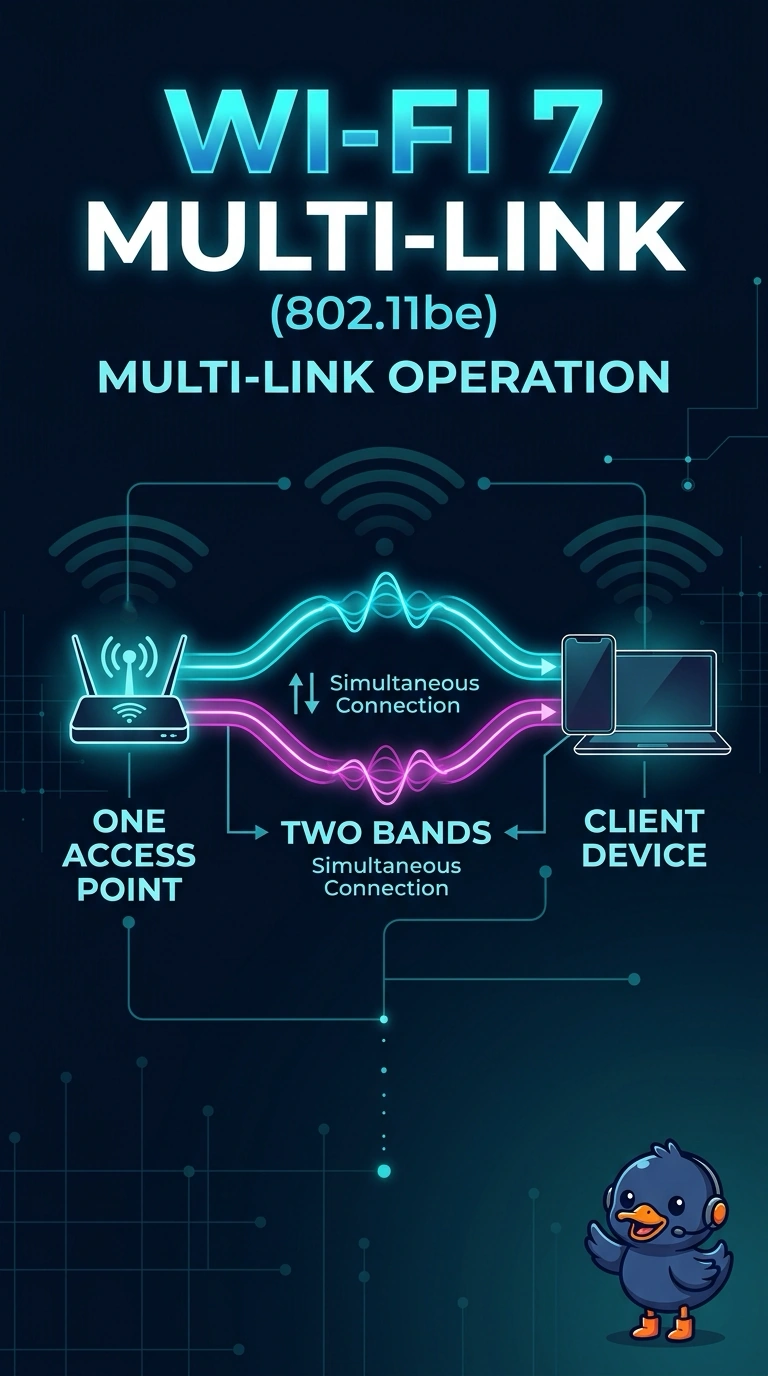
Two bands at once, as one multi-link device, is a Wi-Fi 7 trick. Your Wi-Fi 6 access points can be fast and still have no such link. Do not look for it in the older generations.
Full Explanation
Multi-link operation lets a station use more than one band or link at the same time toward an access point. That capability arrives with 802.11be, which the Wi-Fi Alliance generation name calls Wi-Fi 7. A design that requires it is asking for Wi-Fi 7, not for a setting on an older generation. Wi-Fi 6, 802.11ax, adds OFDMA and other efficiency tools. It does not bond two bands into one multi-link session. A Wi-Fi 6 laptop uses one band at a time even when the access point offers several. Wi-Fi 5, 802.11ac, is a 5 GHz generation. It does not require or provide multi-link operation. The original DSSS PHY is a single-channel, single-band design from the first standard. It does not transmit one client on two bands at once. Exam caveat: both the access point and the laptop have to be Wi-Fi 7 for the multi-link session to form. A Wi-Fi 7 access point with a Wi-Fi 6 laptop falls back to a single link. Operational check: on a test laptop that claims Wi-Fi 7, confirm the association shows more than one link active, and confirm a Wi-Fi 6 laptop in the same seat does not.