
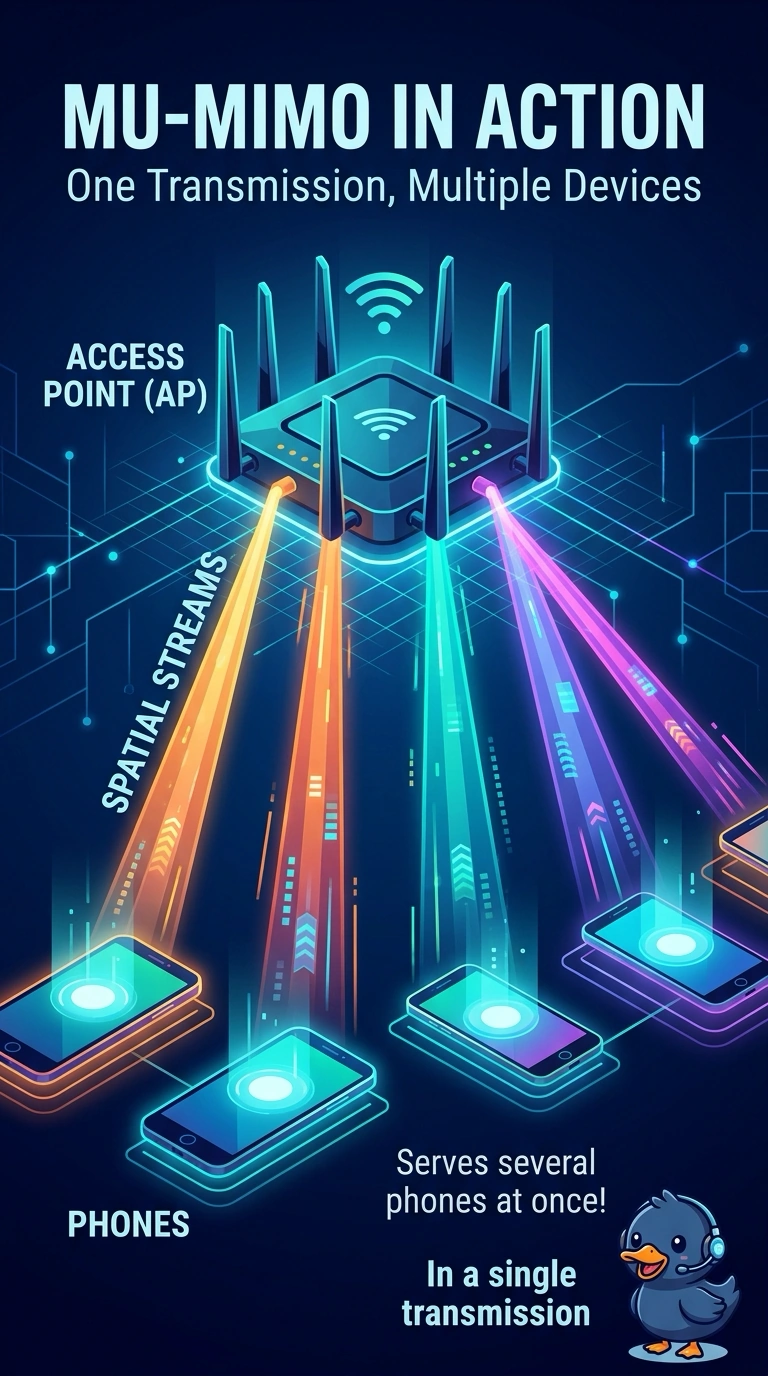
A stadium access point sends traffic to several phones in one downlink transmission, separating them by their location in space rather than by slicing the channel into smaller frequency units. Which feature is that?
Select an answer to reveal the explanation.
Short Explanation
Your access point is separating phones in space and serving them together. That is MU-MIMO. A hidden name does not schedule anyone, and neither does a narrower channel.
Full Explanation
MU-MIMO uses multiple antennas to form spatial streams toward different clients in the same transmission. The stadium access point is serving several phones at once and the separation is spatial. That is MU-MIMO. A narrower 20 MHz channel reduces bandwidth. It does not serve several phones by slowing a symbol, and narrowing the channel still leaves one station on the air at a time. A hidden SSID only removes the name from beacons. Beacons are not a scheduler for user data, and hiding the name does not create spatial streams. A guest anchor tunnels guest sessions to another controller. It separates trust domains by where traffic is terminated, not by forming spatial streams, and a VLAN is not a spatial stream. Exam caveat: the phones have to support the spatial method, and a one-stream phone cannot be part of a multi-stream downlink group. MU-MIMO does not raise a single old phone to four streams. Operational check: on a capture or client statistic, confirm a multi-user spatial transmission to more than one phone, and confirm those phones are capable of it.