
A retail chain in North America is choosing a 2.4 GHz channel plan so neighboring access points do not overlap on 20 MHz channels. Which set meets that goal?
Select an answer to reveal the explanation.
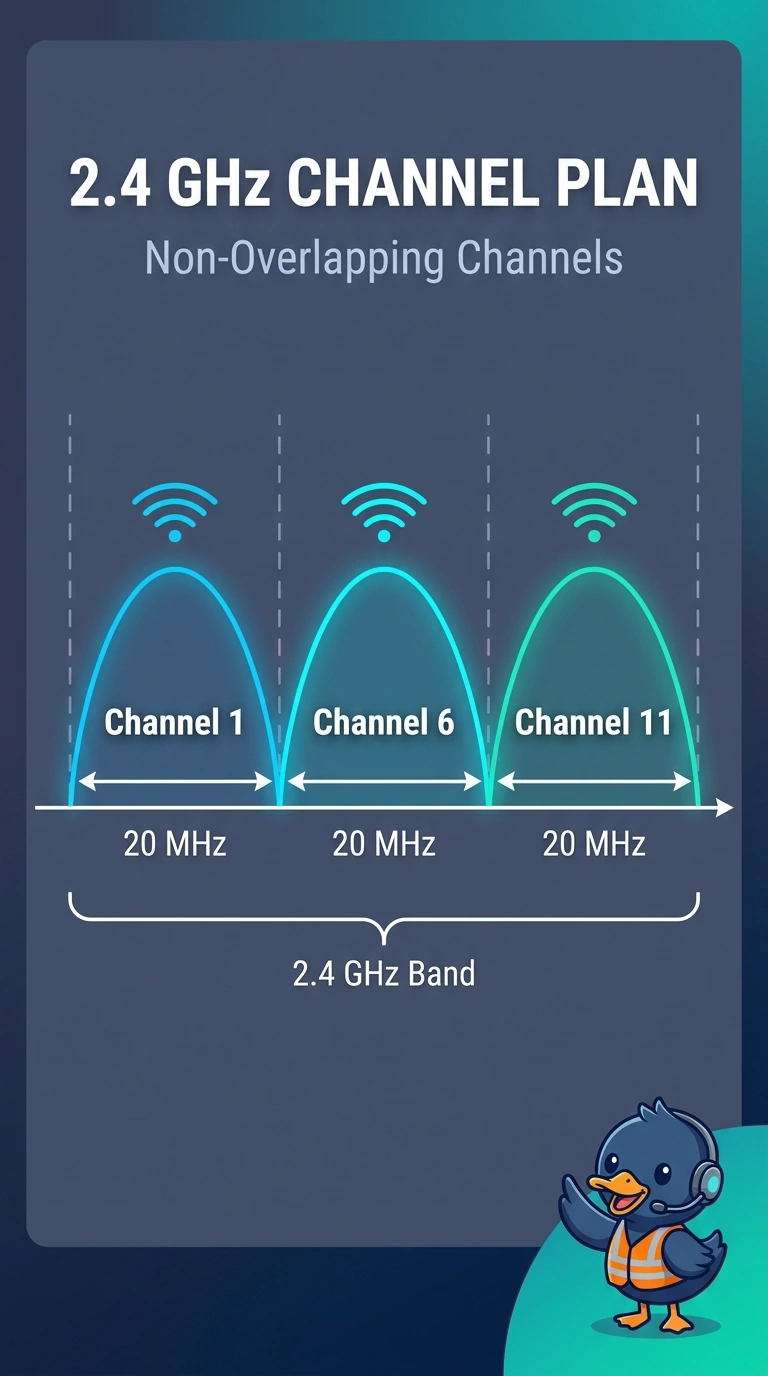
Short Explanation
In the North American 2.4 GHz band, channel centers are close enough that 20 MHz neighbors can overlap. You want channels 1, 6, and 11, whose spacing avoids that overlap. Channels 1, 2, and 3 may look tidy, but their occupied bandwidths pile together rather than separating neighboring access points.
Full Explanation
In the North American 2.4 GHz band, a 20 MHz channel is much wider than the 5 MHz spacing between channel numbers. Channels 1, 6, and 11 are the commonly used non-overlapping set: their centers are far enough apart that the 20 MHz occupied bandwidth does not overlap the neighboring channel. That makes this set the plan that meets the goal. Channels 1, 2, and 3 are adjacent numbers, so their occupied bandwidths overlap heavily; access points using them interfere rather than divide the band. Channels 6, 7, and 8 have the same problem higher in the band: they overlap instead of providing a reuse plan. Channels 36, 40, and 44 are 5 GHz channels in UNII-1. They can form a fine 5 GHz plan, but they are not a 2.4 GHz plan. Exam caveat: some countries allow channel 13, and a four-channel pattern can be designed there. The stated North American plan uses the non-overlapping set of channels 1, 6, and 11. For a practical check, read the channel on each neighboring access point and confirm the floor uses only channels 1, 6, and 11 before checking transmit power.