
In a university hall, many laptops send small frames at once and airtime collapses while each transmission still serves only one station. The access points are Wi-Fi 6. Which mechanism serves several stations in one transmission by dividing the channel?
Select an answer to reveal the explanation.
Short Explanation
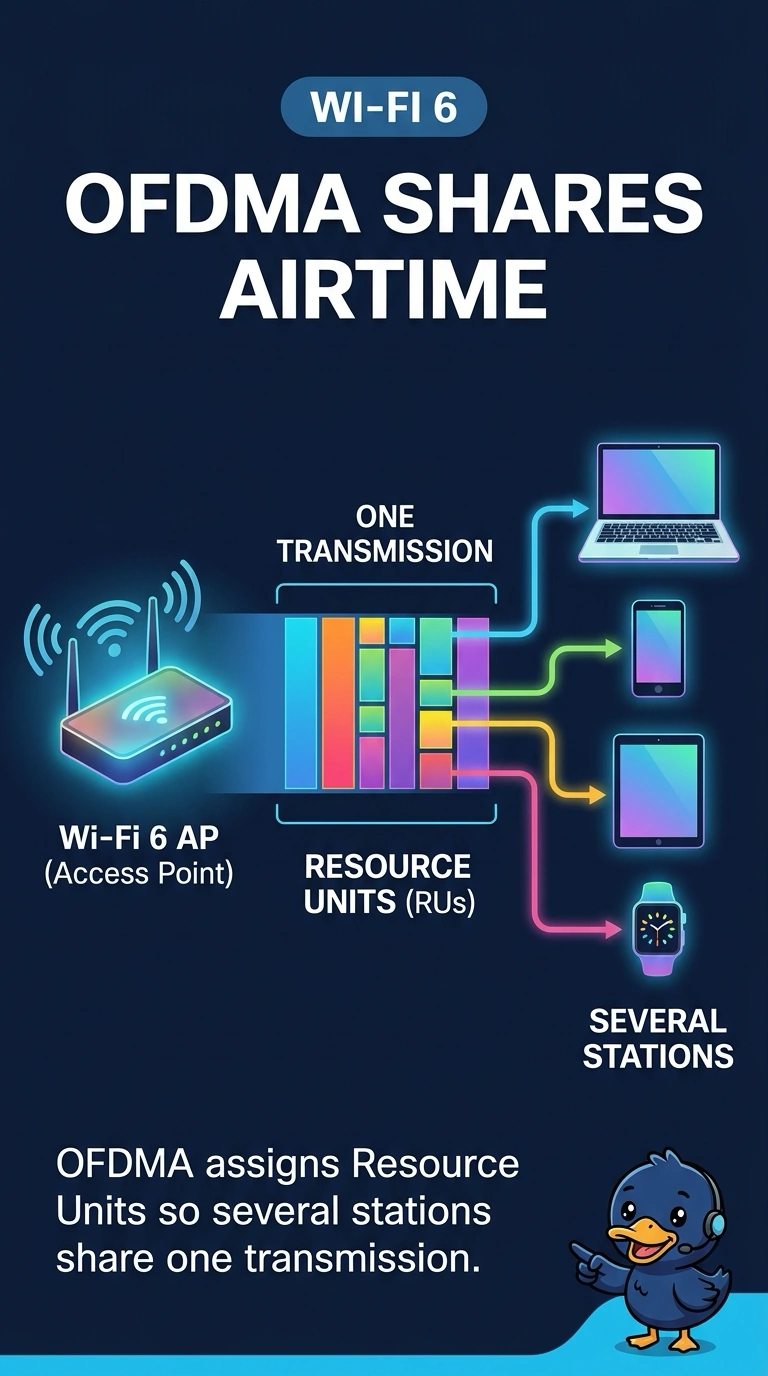
When many stations send small frames, single-user OFDM can leave you waiting for airtime. OFDMA divides the channel into resource units so several stations can share one transmission; a block acknowledgement confirms frames but does not carry their data.
Full Explanation
Wi-Fi 6 (802.11ax) adds orthogonal frequency-division multiple access (OFDMA). The access point divides the channel into resource units and can assign them to different stations in the same transmission. That is useful when many clients each have a small frame, because separate single-user transmissions waste airtime; the Wi-Fi 6 access points in the hall support this mechanism. DSSS is an older single-transmitter spreading method: it does not parcel the channel out to several stations at once, and a shared spreading code is not OFDMA. A narrower OFDM channel still sends one station’s frame at a time. OFDM is the single-user predecessor; narrowing the channel reduces throughput but does not schedule several stations inside one symbol. A block acknowledgement acknowledges several frames, but it is a control function, not a container for the stations’ user data, and it does not divide the channel into resource units. Exam caveat: OFDMA is not MU-MIMO, which separates stations in space using multiple antennas. Here, the requested behavior is dividing the channel into resource units. Practical check: on a Wi-Fi 6 capture or client statistic, confirm resource-unit use during the busy period and verify that clients are associated as 802.11ax stations rather than falling back to a single-user PHY.